

Table of Contents
- What is a technical support engineer?
- What is a field service engineer?
- A head-to-head comparison: Technical support engineer vs. field service engineer
- Key skills for a technical support engineer
- Key skills for a field service engineer
- The career ladder for a technical support engineer
- The career ladder for a field service engineer
- Can individuals switch between roles?
- Which path is better? Breaking down each role
- FAQs
- Find your path at Danaher
When technical professionals consider careers in customer support engineering, the choice often comes down to two distinct paths. Technical support engineers solve complex problems remotely and guide customers through challenges, while field service engineers often travel to customer sites to install, maintain and repair critical equipment. Both roles demand technical expertise and commitment to customer success.
At Danaher, technical support and field service engineers support diagnostic equipment, digital pathology systems and molecular testing platforms that help healthcare professionals save lives. Understanding the distinctions between these career paths helps professionals make informed decisions aligned with their strengths and career goals.
What is a technical support engineer?
A technical support engineer serves as the technical expert customers contact when they encounter challenges with equipment, software or systems. These professionals diagnose issues remotely, troubleshoot complex problems and guide users through solutions via phone, email, video conference, and remote access tools.
At Danaher companies, technical support engineers provide assistance with digital pathology imaging applications, addressing installation challenges, software migrations and hardware functionality. Engineers communicate application features and best practices to end users and server administrators, enabling confident system adoption.
The position requires deep product knowledge across electromechanical equipment, computer systems, complex software and networked systems. Technical support engineers also resolve customer problems or dispatch appropriate resources.
What is a field service engineer?
A field service engineer travels to customer locations to install, repair and maintain equipment directly. These professionals work hands-on with diagnostic systems, performing preventive maintenance, upgrading systems and resolving issues that require physical intervention.
At Danaher, these professionals typically support molecular diagnostic equipment across designated territories, traveling on short notice to hospitals, laboratories and research facilities. The role demands technical troubleshooting skills combined with the ability to work independently in diverse customer environments.
Field service technicians at Danaher handle equipment installation and ensure systems meet compliance standards. Engineers conduct training sessions and build relationships that contribute to service revenue and contract retention.
The position also requires physical capabilities alongside technical expertise. Engineers must lift equipment, manage inventory in service vehicles and potentially work weekend or on call shifts. Some territories require daily field visits, and others involve overnight stays. Those interested in a career as a field service engineer should understand the mobile nature of the work.
[Technical support engineers solve problems remotely, while field service engineers travel to customer sites.]
A head-to-head comparison: Technical support engineer vs. field service engineer
While both career paths share the same end goal of improving customer satisfaction, their typical workdays and career growth paths look very different. Here’s a detailed comparison of the key duties and elements of technical and field service engineers:
The core mission
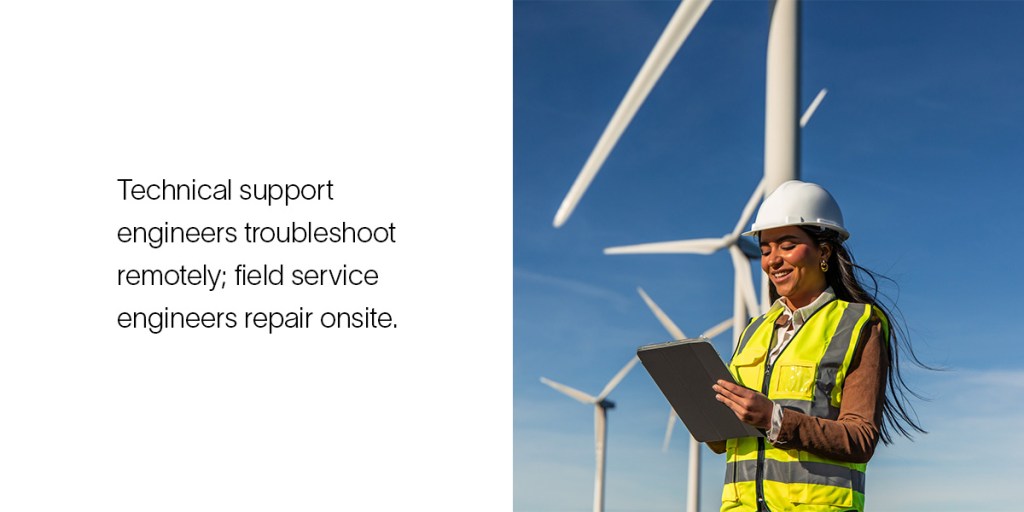
Technical support engineers solve problems through virtual channels. When a laboratory experiences software errors, they remotely access systems, review error logs and guide lab personnel through troubleshooting via phone or video.
Field service engineers solve problems with hands-on intervention. When that same analyzer requires hardware repair, the field service engineer drives to the laboratory, diagnoses mechanical or electrical issues directly, replaces components, calibrates systems, and verifies proper operation before leaving the site.
A day in the life
A typical day for a technical support engineer at Danaher begins with reviewing support tickets or incoming calls. Engineers prioritize cases by urgency, then reach out to customers to diagnose issues. The day might involve guiding a hospital technician through instrument calibration via video call or training a team member on troubleshooting protocols.
Technical support engineers work from desks equipped with multiple monitors, remote access software, and communication tools. Engineers typically work scheduled shifts, including some positions on second or third shifts to provide 24/7 coverage.
A typical day in the job of a field service engineer begins at home or a hotel, reviewing the schedule of customer site visits. The engineer loads equipment into a service vehicle, drives to appointments, and spends hours installing diagnostic systems. After completing installation and training hospital staff, the engineer drives to another facility for preventive maintenance, then documents activities and expenses.
The work environment
Technical support engineers at Danaher typically work from office locations or home offices. Positions at companies like Leica Biosystems offer fully remote arrangements, allowing engineers to support customers nationally while working from dedicated home office spaces.
Field service engineers work primarily at customer sites. A Cepheid field service engineer covering a territory in the Mid-Atlantic region might visit the National Institutes of Health in Bethesda, Maryland, regularly while also serving hospitals and labs throughout Virginia and the District of Columbia.
Travel requirements
Travel is perhaps the biggest distinction between these roles. Technical support engineers experience minimal to no travel in most positions. Danaher field service positions commonly call for up to 75% travel, depending on territory size and customer density.
A field service engineer position in Salt Lake City might cover a multi-state region, requiring regular overnight trips throughout Utah, Idaho and Nevada. Engineers must hold valid passports for potential international travel and maintain reliable vehicles for daily customer visits.
Compensation and benefits
Determining how much a technical support engineer earns is complicated. Compensation typically consists of a base hourly pay or salary, plus benefits. At Danaher, technical support engineers receive competitive hourly rates depending on experience level.
Regarding the salary of a field engineer, compensation structures often include base pay plus travel-related compensation. Field service engineer positions at Danaher offer annual salaries plus bonus and incentive pay. They also receive additional benefits related to travel requirements, including vehicle allowances or company vehicles, per diem for meals, reimbursement for overnight accommodations, and mileage or fuel coverage.
Both roles receive access to Danaher’s comprehensive benefits packages, including medical, dental, and vision insurance, 401(k) plans, and paid time off.
Key skills for a technical support engineer
Technical support engineer qualifications center on deep product knowledge and remote problem-solving capabilities. Engineers must understand the technical architecture of the systems they support, including hardware components, software applications, networking infrastructure and integrated systems.
At Danaher, technical support engineers need specific technical competencies to diagnose issues across complex digital pathology systems remotely:
- Server technologies: Working knowledge of web servers enables engineers to troubleshoot application hosting issues and optimize system performance.
- Database management: Proficiency with Microsoft SQL Server and relational databases enables engineers to diagnose data integrity issues and optimize query performance.
- Operating systems: Understanding Windows Server OS architecture allows engineers to resolve configuration conflicts and permission issues.
- Networking fundamentals: Knowledge of networking concepts helps engineers troubleshoot connectivity problems and diagnose integration challenges.
- Command-line proficiency: Skill with CMD, PowerShell and PuTTY enables advanced diagnostics and remote system access.
Soft skills are also essential to thrive in this role. Problem-solving under pressure comes into play when critical diagnostic equipment malfunctions. Technical support engineers must be able to quickly assess the situation and systematically work toward a resolution. Professionals with software engineering skills often find that technical support engineering positions align with their analytical strengths.
[A field service engineer’s role demands technical troubleshooting skills combined with independence in diverse environments.]
Key skills for a field service engineer

Field service engineer qualifications emphasize mechanical and electrical aptitude combined with strong customer-facing abilities. They often have backgrounds in electronics, engineering or related technical disciplines, and may hold associate or technical trade degrees with two to four years of related experience or equivalent military training.
Success in field service engineering requires a distinct skill combination:
- Mechanical and electrical troubleshooting: Engineers diagnose complex electromechanical systems, identify failing components and perform hands-on repairs that restore equipment to optimal performance.
- Customer relationship management: They build rapport with laboratory directors, communicate professionally during service visits and represent Danaher companies. Their work directly impacts customer satisfaction and contract retention.
- Time management and route planning: Field service engineers often coordinate multiple appointments across territories and prioritize urgent service calls. They maximize productive customer time, which requires strong organizational skills.
- Independent problem-solving: Working alone at customer sites means these engineers must diagnose issues without immediate colleague support while knowing when to escalate for technical assistance.
- Physical capability and stamina: Lifting equipment weighing 50 pounds or more requires significant strength and endurance. Field service engineers use physical capabilities to access systems, which calls for stamina to maintain energy through long days.
- Technical documentation: They record service activities, maintain accurate parts inventory, document expenses and update case management systems to keep operations running smoothly.
The career ladder for a technical support engineer
A technical support engineer’s career progression typically begins with entry-level positions handling routine support cases. Customer technical support specialists may start by resolving standard hardware, software and training-related inquiries while building product knowledge.
Advancement to senior technical support engineer roles brings increased responsibility for complex cases. Further career advancement can lead to supervisory positions managing technical support teams or to transitions into product management, engineering or application specialist roles. Those interested in advancing to a senior role find that technical support engineering provides solid experience in problem-solving and customer interaction.
The career ladder for a field service engineer

Field service engineer career paths begin with territory-based positions covering designated geographic areas. Engineers at Danaher companies start by installing equipment, performing preventive maintenance and handling service calls within their territories.
Advancement to senior field service engineer positions involves taking on more complex equipment and serving as a technical resource for other engineers. Career progression beyond senior roles leads to district or regional service manager positions overseeing multiple engineers and managing territory coverage.
[Danaher encourages internal mobility, offering engineers opportunities to transition between technical support and field service roles.]
Can individuals switch between roles?
One of Danaher’s core values centers on career development and serving as a career catalyst for associates. Danaher actively encourages internal mobility. Professionals can explore different roles across the network of operating companies.
Engineers who start in technical support positions can transition to field service roles if they develop an interest in hands-on work. Similarly, field service engineers who prefer to reduce travel can move into technical support or training positions that leverage their technical expertise in office-based or remote settings.
The innovative Danaher Business System provides a common framework across all operating companies, making transitions smoother. Internal mobility programs and career progression support help engineers navigate career changes within Danaher.
Which path is better? Breaking down each role
The best path depends on the individual’s strengths, ideal work environment and preferences. Compare both roles side by side below:
| Aspect | Technical Support Engineer | Field Service Engineer |
|---|---|---|
| Work environment | Office- or home-based | Customer sites, including hospitals, labs and research facilities |
| Travel | Minimal to none | 40%-75% travel, daily local or regional overnight trips |
| Key responsibilities | Remote diagnostics, phone/email support, case documentation | On-site and installation, hands-on repair, and preventive maintenance |
| Core skills | Product knowledge, communication, and remote diagnostics | Mechanical/electrical aptitude, customer service and physical capability |
| Career path | Technical Support Specialist → Senior TSE → Support Manager | Field Service Engineer → Senior FSE → Regional Service Manager |
FAQs
Choosing between the technical support and field service engineering paths raises important questions about education, skills and day-to-day realities. Here are some FAQs to clarify what each role demands and which path aligns best with individual strengths and career aspirations.
What kind of educational background is typically required for these roles?
Technical support engineer positions at Danaher typically require an associate, vocational or equivalent degree in biology, clinical lab science, biomedical engineering, electrical engineering, or chemistry. Some positions accept equivalent work experience in place of formal degrees.
Field service engineer qualifications generally include an associate or technical trade degree in electronics, engineering or a related field, along with two to four years of related work experience. Military training with relevant technical specialties can substitute for formal degree programs.
How important is customer service in these engineering roles?
Customer service forms a central component of both positions. Technical support engineers must translate complex technical information for customers with varying levels of expertise, remain patient during equipment failures, and maintain professionalism during challenging interactions.
Field service engineers serve as the primary in-person representatives of Danaher operating companies. Building relationships with laboratory directors and representing the company positively in every customer interaction both impact retention and satisfaction.
What are some of the biggest challenges in each role?
Technical support engineers face the challenge of diagnosing and resolving issues without physical access to equipment. When troubleshooting remotely, engineers must rely entirely on customer descriptions and remote access tools. Since they typically work in 24/7 support environments, they may work second shifts, weekends or holidays.
Field service engineers encounter the challenge of extensive travel and time away from home. Spending approximately 75% of the time on the road demands flexibility. Working independently across diverse customer environments means engineers must adapt quickly to different facility cultures and troubleshoot without immediate support from colleagues.
[Ready to make a measurable impact on global health?]
Find your path at Danaher
The decision between pursuing a career as a technical support engineer and becoming a field service engineer shapes everything from daily work routines to long-term lifestyle choices. Both paths serve essential functions within companies like Danaher, where engineering careers focus on solving complex challenges that advance life sciences, diagnostics and biotechnology.
Whether you’re drawn to remote problem-solving or hands-on fieldwork, Danaher has customer service and technical support engineer jobs where your work contributes to innovations that improve lives. You can help healthcare providers, researchers and scientists access the technology they need to advance diagnostics, molecular testing and digital pathology.
Explore customer support jobs across Danaher’s operating companies. Review current Field Service Engineer roles or browse Technical Support Engineer openings to find the path that aligns with your skills and career goals. Join a team where you’ll accelerate your career while making a measurable impact on global health.