

Table of Contents
- What does an electrical engineer do?
- What skills do you need to be an electrical engineer?
- What are the education and experience requirements?
- What is the career path for an electrical engineer at Danaher?
- Other ways to support your electrical engineering career
- Find your future in electrical engineering at Danaher Corporation
The electrical engineer career path is filled with decisions, such as which degree to pursue, which skills to prioritize and which industries offer the most rewarding opportunities.
Understanding how to become an electrical engineer starts with covering core responsibilities, essential skills, education requirements, career progression and preparation steps. At Danaher, engineers contribute to diagnostic equipment, patient monitoring systems and lifesaving biomedical devices. These innovations serve scientists and medical professionals worldwide.
What does an electrical engineer do?
Electrical engineers shape the technologies that power modern life. From medical diagnostics to automation systems, these professionals design, test and refine the electrical systems and components that drive innovation across industries.
Core responsibilities and industry specializations
Electrical engineers work across diverse sectors, including aerospace, telecommunications, renewable energy and semiconductor manufacturing. Industry specializations shape how these responsibilities manifest. In medical device hardware, engineers develop circuitry for diagnostic instruments and patient monitoring systems.
The daily work of an electrical engineer varies depending on the industry and specialization, but several core responsibilities remain consistent:
- Design electrical systems and components: Engineers develop schematics and specifications that meet technical and safety requirements.
- Develop prototypes and validate designs: This segment includes selecting appropriate components and using testing and simulation to ensure functionality.
- Test and evaluate equipment performance: Engineers identify failure points and implement improvements through iterative testing.
- Document design decisions and compliance data: Recording test results, design rationale and regulatory information accompanies every phase of development.
The impact of electrical engineering at a Danaher operating company
At Danaher operating companies, electrical engineering work extends beyond technical problem-solving. It contributes to innovations that improve global health. Engineers develop diagnostic platforms that enable faster, more accurate disease detection.
Patient monitoring systems designed by Danaher engineers provide real-time data that helps clinicians make informed decisions. Environmental and applied solutions include instruments that monitor water quality and ensure safety standards. Our focus on life sciences and diagnostics creates opportunities for engineers to work on products with direct human impact.
Danaher’s organizational structure supports this work. Operating companies within the Danaher ecosystem specialize in different domains, from particle analysis to water quality monitoring. This structure gives engineers exposure to diverse applications. It enables collaboration across teams, as engineers share insights and leverage the Danaher Business System (DBS) to drive continuous improvement.
What skills do you need to be an electrical engineer?
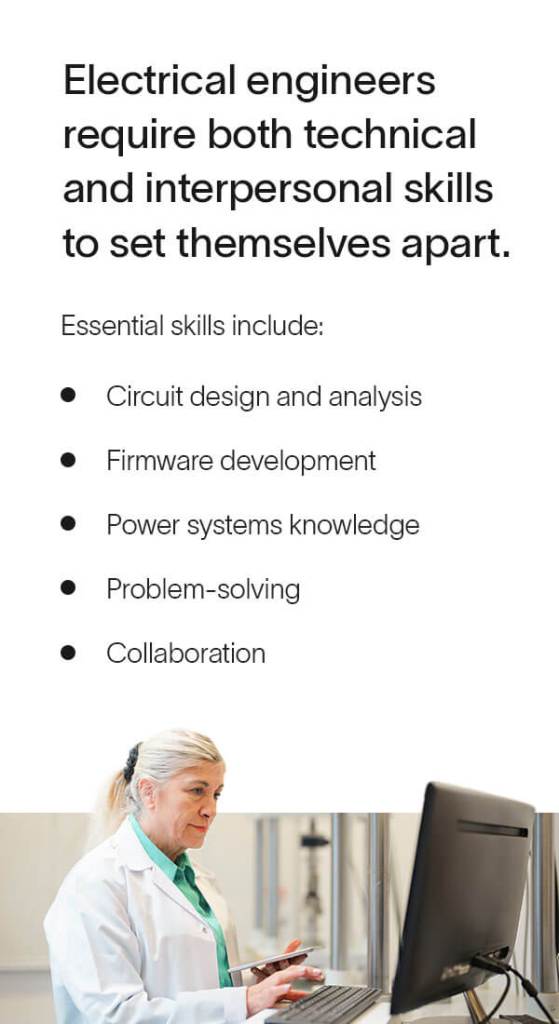
Success in electrical engineering requires a combination of technical knowledge and professional capabilities. Engineers must master the principles of circuit design and power systems, but they also need problem-solving skills, collaboration habits and the ability to communicate complex ideas clearly.
Foundational technical and professional skills
Technical proficiency forms the foundation of an electrical engineer’s skill set. Essential technical skills include:
- Circuit design and analysis: Understanding how current, voltage and resistance interact allows engineers to create functional systems and troubleshoot issues.
- Printed circuit board layout: Proper layout practices prevent noise, heat issues and electromagnetic interference.
- Firmware development: Writing code that controls hardware requires understanding both software logic and hardware constraints, particularly for embedded systems.
- Power systems knowledge: Engineers calculate power requirements, design voltage regulation circuits and ensure thermal management across applications.
- Signal processing and communication protocols: Familiarity with protocols like I2C, SPI, UART and CAN is essential for modern connected devices.
Professional skills complement technical expertise and are equally important for career success:
- Problem-solving: When prototypes fail, engineers analyze symptoms, form hypotheses and test solutions systematically.
- Collaboration: Cross-functional teams include mechanical engineers, software developers, quality specialists and regulatory experts, requiring effective teamwork.
- Communication: Engineers document designs, write test reports and present findings to stakeholders, often explaining technical concepts to non-engineers.
The ability to integrate technical knowledge with professional capabilities distinguishes effective engineers from those who struggle to translate expertise into results.
How Danaher fosters growth with the Danaher Business System
DBS is a framework for continuous improvement that shapes how work is done across all Danaher operating companies. For engineers, DBS is more than a business tool. It’s a system for personal and professional development that builds skills applicable throughout an entire career.
DBS consists of three core areas:
- Fundamentals
- Growth Lean
- Leadership
Each area provides tools and methodologies that help associates identify opportunities, solve problems and deliver value. Engineers apply DBS principles daily, using tools like root cause analysis to investigate failures and voice of the customer exercises to understand user needs. The framework encourages a growth mindset, where engineers experiment, learn from setbacks and refine their approaches.
This culture of continuous improvement means that early-career engineers receive mentorship and guidance as they develop expertise. Senior engineers continue learning, applying DBS tools to complex challenges and sharing knowledge with colleagues.
DBS also creates a common language across operating companies. An engineer who moves from one Danaher company to another can apply the same problem-solving methods and quality standards. This consistency supports internal mobility and makes role transitions smoother.
What are the education and experience requirements?
The journey to becoming an electrical engineer begins with a strong educational foundation and hands-on experience. Understanding how long it takes to become an electrical engineer helps aspiring professionals plan their path and set realistic expectations.
Educational pathways for aspiring engineers
A Bachelor of Science in electrical engineering is the standard entry point for most electrical engineering roles. Accredited programs typically require four years of full-time study and cover core subjects that provide the analytical and technical foundation for engineering work:
- Circuit theory and electronics: Understanding voltage, current, resistance and semiconductor devices forms the basis of electrical engineering.
- Electromagnetics and signals: These courses cover wave propagation, transmission lines and signal processing fundamentals.
- Control systems and power systems: Engineers learn to design systems that regulate behavior and manage electrical energy.
- Mathematics: Calculus, differential equations and linear algebra provide the analytical tools needed for engineering analysis.
Laboratory courses offer hands-on experience with oscilloscopes, function generators and circuit simulation software. Capstone projects challenge students to design and build functional systems, applying theoretical knowledge to practical problems.
Related degrees, such as computer engineering or electronics engineering, also prepare students for roles in electrical engineering. Computer engineering programs emphasize digital systems and embedded computing, creating graduates who bridge hardware and software domains.
Graduate degrees (Master of Science or PhD) are common for engineers pursuing research roles or specialized positions in areas like radio frequency design or power electronics. Graduate education allows deeper exploration of specific topics and often includes research that contributes to the field’s knowledge base.
Why hands-on experience is critical

Academic knowledge provides the foundation, but hands-on experience is where engineers develop practical competence. Internships and co-op programs give students the opportunity to work on real projects under the guidance of experienced engineers.
These experiences expose students to industry practices, tools and workflows that aren’t covered in classroom settings. Internships also help students understand which specializations align with their interests. For engineers entering life sciences technology roles, hands-on experience with regulated environments is particularly valuable. Understanding design controls, risk management and verification processes prepares engineers for the rigor required in medical device development.
If you’re looking for hands-on experience, the Danaher Internship Program provides a foundational 10-12 week experience. It allows graduates to experience the exciting field of biomedical technology within the framework of DBS.
What is the career path for an electrical engineer at Danaher?
A career in electrical engineering offers multiple trajectories, with opportunities to deepen technical expertise, take on leadership roles, or transition between industries. Exploring electrical engineering career pathways is an important step in your career journey.
Typical career progression
Career progression in electrical engineering typically follows a structured path:
- Entry-level engineers (Electrical Engineer I or Associate Electrical Engineer): Entry-level roles focus on executing tasks under supervision, like designing circuits, conducting tests and documenting results.
- Mid-level engineers (Electrical Engineer II or III): Mid-level engineers lead portions of projects, make design decisions and mentor junior team members.
- Senior engineers: Senior positions come with significant technical responsibility. You may be responsible for defining system architectures, evaluating design alternatives and ensuring that projects meet technical and business requirements.
- Principal engineers: Principal engineers represent the highest individual contributor levels, recognized for deep expertise and contributions to the field.
The highest-paying job for an electrical engineer is typically a senior technical position. Specialized roles in emerging technologies and engineering leadership also typically offer the most competitive compensation packages.
Engineers can also transition into leadership roles. Engineering managers oversee teams, allocate resources and align technical work with business goals. Directors and vice presidents of engineering set strategic direction and manage multiple teams or product lines.
Internal mobility at Danaher
At Danaher, internal mobility is a defining feature of career development. Engineers are encouraged to explore roles across different operating companies to gain exposure to new industries and applications. An engineer might develop laboratory instruments, then move to environmental solutions, working on water quality monitoring systems. This mobility builds versatility and prevents career stagnation.
Our commitment to internal movement means that engineers can refresh their careers without leaving the organization. Resources like our guide on how to become a senior engineer provide practical advice for advancing within our companies.
Job outlook and emerging technologies in diagnostics

The job outlook for electrical engineers remains strong. According to the U.S. Bureau of Labor Statistics, employment in architecture and engineering occupations is projected to grow, with electrical and electronics engineers experiencing steady demand. The median electrical engineering salary — $118,780 as of 2024 — reflects the value of their expertise and the complexity of their work.
Several key factors are creating opportunities for electrical engineers:
- Internet of Things (IoT): The growth of IoT creates opportunities for engineers who can design connected devices. In medical diagnostics, IoT-enabled instruments transmit data to cloud platforms for analysis, enabling remote monitoring and predictive maintenance.
- Advanced diagnostic technologies: Wearable health monitors, point-of-care testing devices and molecular diagnostic platforms require electrical engineers who can integrate sensors, signal processing and user interfaces into compact, reliable systems.
- Automation and artificial intelligence: AI is reshaping diagnostic workflows. Engineers design hardware that supports AI algorithms, ensuring data acquisition is accurate and timely. Embedded AI, where machine learning models run directly on devices, requires engineers to optimize firmware and hardware for computational efficiency.
Engineers who understand wireless communication, low-power design and security protocols are well-positioned for in-demand electrical engineering jobs across multiple sectors.
The combination of a strong job outlook, competitive salary levels, and opportunities to work on meaningful projects makes it clear that an electrical engineering degree can be worthwhile. Roles in life sciences and diagnostics offer the added benefit of contributing to innovations that improve health outcomes.
Other ways to support your electrical engineering career
Building a career in electrical engineering extends beyond earning a degree. Pursuing professional credentials and building familiarity with industry standards increases competitiveness and demonstrates commitment to the field.
Obtaining a professional engineer (PE) license
The PE license represents the highest standard of competence in the engineering profession. While not required for all electrical engineering roles, the PE license is valuable for engineers who sign off on designs, work in consulting or want to pursue certain government positions.
Earning a PE license involves several steps:
- Graduate from an ABET-accredited program: Candidates must complete an accredited engineering degree before pursuing licensure.
- Pass the Fundamentals of Engineering (FE) exam: This exam tests knowledge of core engineering principles and grants engineer-in-training status upon passing.
- Gain professional experience: Most states require four years of qualifying experience under the supervision of a licensed PE.
- Pass the Principles and Practice of Engineering (PE) exam: This discipline-specific exam covers topics such as power systems, electronics, control systems and communication systems.
The National Council of Examiners for Engineering and Surveying administers FE and PE exams and provides resources for candidates. While PE licensure is more common in power systems and construction-related roles, it demonstrates a commitment to professional standards that can distinguish candidates in any specialization.
Pursuing certifications like IPC standards
For engineers working in electronics manufacturing, particularly in medical devices, familiarity with industry standards is essential. IPC standards define quality requirements for printed circuit boards, assembly processes and workmanship. These standards ensure designs meet reliability expectations and can be manufactured consistently. IPC-6012EM, for example, specifies requirements for rigid printed circuit boards used in high-reliability applications, including medical devices.
Engineers who understand these standards can design boards that balance performance, manufacturability and cost. Certifications in IPC standards demonstrate proficiency and can be pursued through IPC-authorized training centers. While not always required, these credentials signal that an engineer understands the rigor necessary for mission-critical electronics.
Find your future in electrical engineering at Danaher Corporation

A career in electrical engineering offers the opportunity to solve complex problems, develop innovative technologies and contribute to work that improves lives. For engineers who value continuous learning, collaboration and meaningful impact, Danaher provides a unique environment to accelerate professional growth.
With opportunities for internal mobility across operating companies, engineers can build dynamic, evolving careers without leaving the organization. Explore open positions in electrical engineering at Danaher and discover how expertise can drive innovation that makes a difference. Visit our careers page to learn more and apply today.