Application specialists love science. They spent years mastering pipetting techniques, troubleshooting Western blots and optimizing polymerase chain reaction (PCR) protocols. But somewhere between the third replicate and the fourth grant rejection, a question often crept in — is this it?
Scientists who crave variety, human connection and the satisfaction of seeing their expertise make an immediate impact aren’t alone. Thousands of professionals are discovering a career that lets them stay rooted in rigorous science while escaping the repetitive confines of the bench: application specialist.
Table of contents
- The Bridge Between Science and Solutions: What Is an Application Specialist?
- 3 Signs to Move From the Bench to Business
- Core Responsibilities: A Day in the Life of an Application Specialist
- Education and Skills: How to Become an Application Specialist
- Career Entry Paths: How to Break In
- Career Outlook: Salary and Progression
- Why Danaher Is the Premier Launchpad for Application Specialists
- Ready to Accelerate Your Impact?
The Bridge Between Science and Solutions: What Is an Application Specialist?

An application specialist, often called a field application scientist or technical application scientist, is the critical link between research and development (R&D) innovation and real-world implementation. While bench scientists generate data, application specialists ensure complex life science technologies actually work in the hands of customers.
The role encompasses four core aspects:
- Customer training: Traveling to customer sites — such as hospitals, universities and biotech labs — to install new instruments and teach staff how to operate them effectively
- Advanced troubleshooting: Diagnosing why an experiment failed by investigating the sample, reagent, software or user technique, often solving problems that stump local teams
- Method development support: Helping customers optimize protocols for their specific applications, whether it’s improving peak resolution on a mass spectrometer or enhancing signal-to-noise ratios in flow cytometry
- Product demonstrations: Supporting sales teams by proving to prospective clients that the technology works on their real samples, not just on idealized standards
What makes this role unique is the hybrid skill set it demands. An application specialist needs technical knowledge combined with customer-facing skills like teaching, presenting and building trust with frustrated users who need solutions yesterday.
Why This Role Matters
Consider the complexity of modern life sciences research. A study published in 2024 examined protein interactions in malaria resistance mechanisms, requiring advanced techniques like heme-binding affinity assays and in silico molecular docking.
Without an expert application specialist to guide researchers through instrument setup, method optimization and data interpretation, even the most sophisticated equipment becomes a very expensive paperweight. Ultimately, application specialists accelerate discoveries that save lives.
3 Signs to Move From the Bench to Business
This career transition may not be suitable for every scientist. However, if the following descriptions resonate, a scientist might be an ideal candidate for application specialist jobs.
1. Love Science but Dislike Repetition
The application scientist career path offers science in motion. Every customer brings a unique challenge. One day, an application specialist is troubleshooting a genomics workflow for a cancer diagnostics lab — the next, they’re training a pharmaceutical team on a new bioreactor system. The intellectual stimulation remains high, but the monotony disappears.
2. A Willingness to Jump Into the Action
Application scientists are always ready to help out a colleague, volunteer to present at lab meetings or explain something to a new employee. For those who feel energized by teaching and problem-solving with others rather than working in isolation, this career will feel like a natural fit.
3. Crave Tangible Impact
Academic research can take years to publish, and clinical translation might take decades. Application scientists solve a customer’s problem in hours or days. They train a team on Monday, and by Friday, they’re generating publication-quality data. This immediate, visible impact on human health research provides a level of professional satisfaction that the bench often can’t match.
Core Responsibilities: A Day in the Life of an Application Specialist
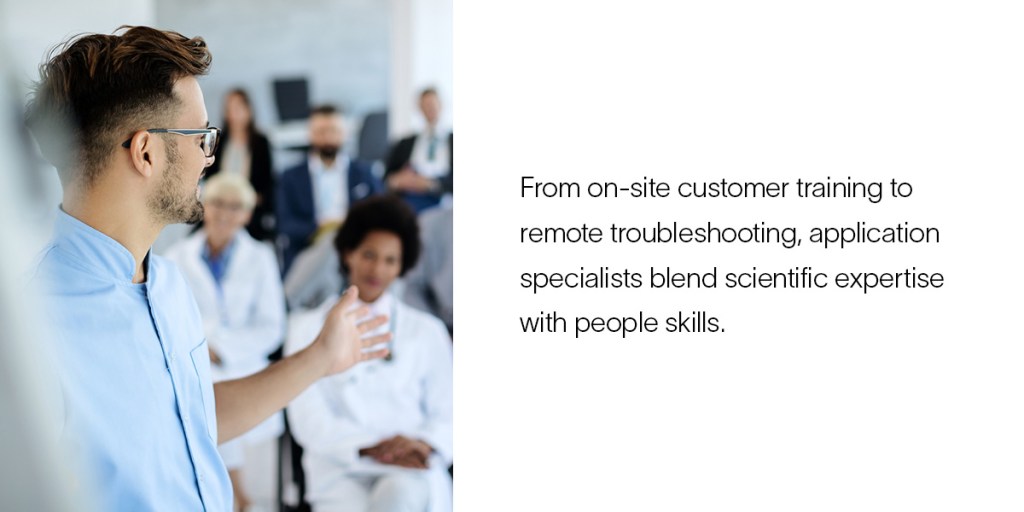
As an application specialist, no two days are identical, but certain patterns define the rhythm of this career.
On-Site Customer Success and Method Development
Field application specialists spend about 50% to 70% of their time traveling to customer sites. A typical visit might involve installing a new liquid chromatography-mass spectrometry system in a pharmaceutical quality control lab, and then spending two days training the team.
Method development support is where an application specialist’s scientific expertise truly shines. Customers don’t just need to know which buttons to push. They need help optimizing their specific assays. An application specialist might adjust gradient profiles to improve compound separation, tweak detector settings to reduce background noise or develop custom protocols for analyzing novel therapeutic molecules. That’s applied science at its finest.
Remote Support, Documentation and Webinar Delivery
Not every interaction happens on-site. Between travel assignments, application specialists field customer calls, host webinars for user groups and create technical documentation like:
- Application notes
- Troubleshooting guides
- Best practice videos
This content supports users globally and builds a scientist’s reputation as a subject matter expert. Remote support requires patience and diagnostic creativity. When a customer in Germany emails at 2 a.m. local time because their instrument is down, a research scientist becomes a detective, asking targeted questions to isolate whether the problem is hardware, software or user error.
Pre-Sales Demonstrations
Before a hospital or biotech company invests hundreds of thousands of dollars in new equipment, they want proof it will work for their applications. Application specialists conduct product demonstrations, often using the customer’s own samples. Their ability to generate compelling data in a high-pressure environment directly influences purchasing decisions and drives company revenue.
Travel Expectations and Work Environment
The travel component is both a feature and a requirement. Field roles typically involve a lot of traveling, including international assignments for global accounts. Between trips, these scientists work remotely or from a home office, catching up on documentation, training modules and customer follow-ups. This lifestyle is energizing for the right kind of person.
Education and Skills: How to Become an Application Specialist
For those who want to pursue a career as an application specialist, here’s a general look at education and skills expectations.
Scientific Background Required
The nonnegotiable foundation for this role is a degree in life sciences, including:
- Biology
- Chemistry
- Biochemistry
- Molecular biology
- Related field
Most positions require at least a bachelor’s degree plus three to five years of hands-on lab experience. However, some specialized roles — particularly in cutting-edge fields like genomics or proteomics — may require a master’s degree or doctoral degree.
Certifications and Skills: Are There Certifications for Application Specialists?
Compared to fields like project management or regulatory affairs, there’s no universal application specialist certification. However, vendor-specific training programs and soft-skill certifications in areas like public speaking, technical writing or customer relationship management can strengthen candidacy.
The most critical skills are interpersonal, including:
- Presentations and teaching: Scientists must translate complex technical concepts into language that non-experts understand.
- Active listening: Understanding the customer’s actual problem, not just the symptoms they describe, requires patience and empathy.
- Relationship building: Customers become partners. The ability to build trust is essential.
Technical Proficiency
An application specialist must be an expert in the technology they support. If they work on flow cytometers, they need to understand fluorescence optics, compensation matrices and gating strategies. If they support next-generation sequencing platforms, they need to grasp library preparation, cluster generation and bioinformatics pipelines. Their existing lab experience should give them a strong technical foundation to build upon.
Career Entry Paths: How to Break In
Learning how to become an application specialist requires understanding the different entry points into this career.
From Bench Scientist
This path is the most common. Postdocs, research associates and lab managers who have spent years mastering specific techniques — including mass spectrometry, microscopy or genomics — transition into roles supporting those same technologies. Their deep hands-on experience makes them credible to customers who are expert users themselves.
From Field Service Engineer
Field service engineers (FSEs) install and repair instruments but typically focus on hardware troubleshooting over scientific applications. FSEs with strong science backgrounds sometimes transition into application specialist roles, using their customer interaction experience while deepening their scientific impact.
From Technical Support
Remote technical support roles, such as phone or email-based troubleshooting, can serve as stepping stones to field-based application specialist jobs. Learn the product line, develop diagnostic skills and build relationships with customers before transitioning to a travel-intensive role.
Regardless of the entry point, the key is demonstrating both technical credibility and customer-facing skills. Highlight any teaching, training or presentation experience. Volunteer to mentor new lab members or lead journal clubs. These experiences prove essential communication skills.
Career Outlook: Salary and Progression
Learn how much application scientists make in the U.S., depending on unique goals and growth projections.
Salary Expectations
According to a 2025 BioSpace report, technical commercial roles in life sciences saw significant salary growth in 2024, with total compensation often exceeding traditional academic research positions. While exact figures vary, entry-level application specialists typically earn base salaries in the range of $70,000 to $90,000 with total compensation reaching $80,000 to $100,000.
Senior application specialists with five to seven years of experience can command about $100,000 to $130,000 in base salary with total compensation packages exceeding $140,000 when performance bonuses are included.
The Career Ladder
The application specialist career path offers clear progression:
- Application specialist: Entry-level role focused on customer support and training
- Senior application specialist: Five to seven years of experience handling more complex accounts and mentoring junior team members
- Application manager: Leading a regional or product-focused team of specialists, balancing customer support with strategic planning
- Product specialist or product manager: Transitioning from field support to product development, using customer feedback to guide R&D priorities and market strategy
Many professionals also pivot laterally into technical sales, business development or marketing, using their deep product knowledge and customer relationships.
Why Danaher Is the Premier Launchpad for Application Specialists
Not all life science companies are created equal when it comes to career development. Danaher Corporation stands out for several reasons.
A Network of Industry-Leading Companies
Danaher is a family of operating companies spanning life sciences research tools, diagnostics and laboratory equipment. When you join as an application specialist, you might support products from:
- Beckman Coulter Life Sciences (cell analysis and genomics)
- Leica Microsystems (advanced imaging)
- SCIEX (mass spectrometry)
- Cytiva (Bioprocessing)
This breadth creates extraordinary internal mobility. If you start in flow cytometry but develop an interest in proteomics, pathways exist to transition within the Danaher ecosystem.
The Danaher Business System
What truly differentiates Danaher is the Danaher Business System (DBS), a proprietary framework for continuous improvement rooted in lean manufacturing and problem-solving methodologies. As an application specialist at Danaher, you don’t just learn product specs — you learn systematic approaches to diagnosing problems, implementing solutions and measuring results.
Think of DBS as a mini-MBA focused on operational excellence. The skills you develop, such as root cause analysis, process optimization and data-driven decision-making, are transferable to any future leadership role, whether you stay in life sciences or pivot to another industry.
Global Mobility and Inclusion
Danaher operates in over 60 countries, offering application specialists opportunities to work in North America, Europe and Asia-Pacific. The company’s commitment to inclusion and belonging ensures all perspectives are valued, with initiatives focused on gender equity, pay fairness and creating environments where all associates thrive.
For professionals early in their careers, the global platform accelerates learning. Supporting customers in Shanghai, Munich and Boston exposes you to different regulatory environments, research cultures and customer expectations, making you a more versatile and valuable professional.
Innovation at the Speed of Life
Finally, working at Danaher means contributing to technologies that directly impact human health. Recent press releases highlight partnerships in AI-driven diagnostics, genomic medicine and digital pathology. When you support a customer using a Danaher instrument to develop a new cancer therapeutic or diagnose a rare genetic disease, your work has meaning beyond quarterly revenue targets.
Ready to Accelerate Your Impact?
The application specialist career offers a rare combination — the intellectual rigor of science, the variety of travel and the satisfaction of solving problems that directly advance medical research. If you’re ready to build a career that spans continents and technologies, the life sciences industry needs your expertise. Companies like Danaher and its operating companies are actively seeking scientists who can bridge the gap between innovation and implementation.
Explore opportunities within the Danaher family of companies and see how the Danaher Business System develops future leaders. The world is waiting for the solutions only you can deliver. Learn more about our diagnostics and life sciences careers today.