

Table of Contents
- What does a clinical scientist do?
- What qualifications are needed to be a clinical scientist?
- Essential hard and soft skills for success
- Key certifications and training that make you stand out
- Clinical scientist salary and job outlook
- The clinical scientist career path: from entry-level to leadership
- How to find and land a clinical scientist job
- Why build a career in clinical science at Danaher?
- Browse open clinical scientist jobs at Danaher
Clinical science bridges laboratory discoveries with real-world patient care. For professionals with advanced scientific training who want their work to accelerate diagnostics and medical device innovation, a career as a clinical scientist offers a direct path to measurable impact. The route to this role isn’t always clear, and the qualifications, certifications and career trajectory can vary significantly across employers and sectors.
This guide provides a complete roadmap for how to become a clinical scientist in medical diagnostics and device development. It covers the day-to-day responsibilities that define the role and unpacks the educational background, certifications and career progression from entry-level scientist to leadership positions.
What does a clinical scientist do?
Clinical scientists serve as the critical link between laboratory research and real-world patient applications in the medical device and diagnostics industry. These professionals are responsible for conducting research to improve human health through clinical investigation and research and development (R&D) that validates whether new technologies perform safely and effectively in healthcare settings.
Clinical scientists focus on applied research. They take existing innovations and ensure they meet the rigorous standards required for clinical use. The work centers on designing clinical studies that test diagnostic tools and medical devices in real patient populations, then analyzing the data to demonstrate both safety and clinical utility.
This process requires understanding the science behind the technology, as well as the regulatory frameworks governing medical product approval.
A day-in-the-life snapshot
Clinical scientists perform a range of critical functions, including:
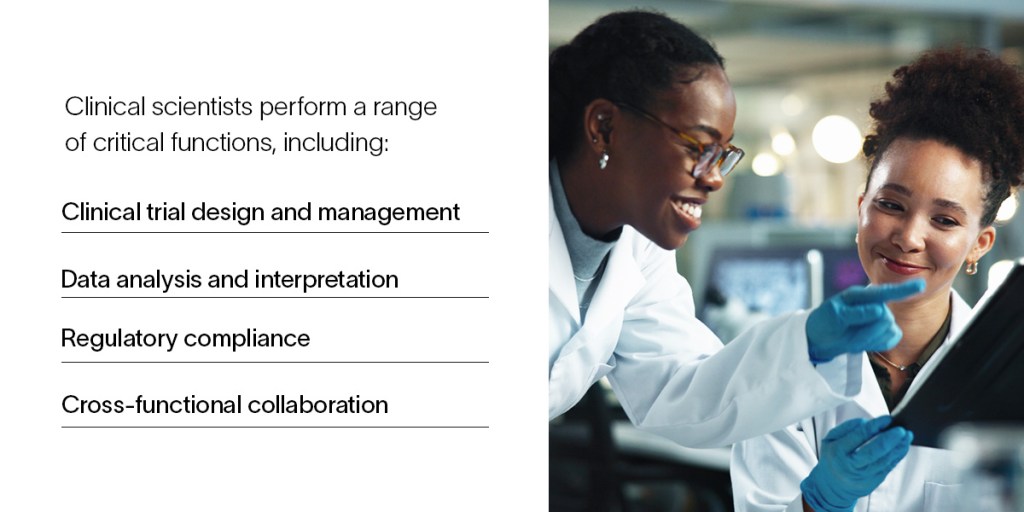
- Clinical trial design and management: Clinical scientists are responsible for designing and managing clinical trials. They are essential in every phase, from protocol development to execution. They determine study parameters, patient populations and endpoints.
- Data analysis and interpretation: Reviewing trial results, performing statistical assessments and identifying patterns that validate device performance are common daily duties for clinical scientists.
- Regulatory compliance: These professionals ensure that studies meet FDA requirements for medical device development by preparing documentation for regulatory submissions. They often serve as the scientific voice in discussions with regulatory bodies.
- Cross-functional collaboration: Clinical scientists work closely with R&D teams, translating technical specifications into clinical study designs and partnering with clinical affairs colleagues. They also manage site relationships and communicate findings to commercial teams planning product launches.
Daily responsibilities vary by product development stage, but these core activities remain consistent.
Clinical science at Danaher
Clinical scientists at Danaher operating companies play a pivotal role in bringing innovative medical device solutions to market across the diagnostics, life sciences and biotechnology segments. They validate diagnostic instruments that process thousands of patient samples daily in hospital laboratories.
Our clinical scientists have also designed studies proving that molecular diagnostic tests deliver accurate results at the point of care. Some clinical scientists also generate clinical evidence supporting pathology solutions that help detect cancer earlier.
Where clinical scientists typically work matters significantly for their career trajectory. Clinical scientists at Danaher contribute to regulatory strategy, participate in scientific advisory discussions and help shape the clinical evidence that positions innovations as standard of care. The Danaher Business System provides structured methodologies for optimizing trial design, accelerating timelines and ensuring quality at every step.
What qualifications are needed to be a clinical scientist?
The educational bar for clinical scientist roles sits high, reflecting the complexity of the work. The degree requirements typically include a postgraduate degree—either a Master’s or PhD in life sciences, biomedical sciences, molecular biology or a related field.
Some clinical scientists enter the field with an MD, particularly physicians transitioning from clinical practice who focus on clinical trial oversight or regulatory strategy. The specific degree matters less than the depth of scientific training and research experience gained during graduate work.
Hands-on experience in a clinical research setting forms the second critical component. Many professionals enter clinical scientist jobs after completing postdoctoral research, working in academic medical centers or gaining experience in contract research organizations. This practical exposure—designing studies, working with clinical data, navigating institutional review boards—provides the foundation that academic coursework alone cannot deliver.
When considering how long it takes to become a clinical scientist, the timeline typically spans six to 10 years. This includes four years for an undergraduate degree, two to six years for graduate education and often one to three years gaining direct clinical research experience before landing a clinical scientist position.
Essential hard and soft skills for success
While having the right qualifications is crucial to landing a role as a clinical scientist, it’s also important to build the hard and soft skills to help you thrive. Here’s what’s typically valued in this field:
Hard skills center on technical competency and include:
- Biostatistics and data analysis: These skills help you design statistically sound studies and interpret complex datasets.
- Clinical trial design knowledge: Understand phases, endpoints, patient stratification and protocol development with clinical trial design knowledge.
- Regulatory expertise: Build familiarity with FDA requirements, ISO standards and international regulations.
- Technical proficiency: Those with experience working with clinical data management systems and statistical software are typically prioritized as candidates.
Soft skills determine how effectively scientists can translate technical expertise into results:
- Communication skills: Explaining complex scientific concepts to regulatory reviewers, training clinical site staff and presenting findings to executive leadership are crucial.
- Problem-solving abilities: Clinical scientists should be able to adapt when study results don’t match expectations or when regulatory feedback requires protocol modifications.
- Attention to detail: These professionals need the skills to create documentation that passes regulatory scrutiny on the first review.
For professionals seeking a competitive advantage, these in-demand skills are applicable across scientific disciplines and strengthen career resilience.
Key certifications and training that make you stand out
Having the right combination of certifications, training and skills can help you stand out among other candidates. Here are some of the certifications and training options to consider:
Professional certifications
Professional certifications aren’t always mandatory for clinical scientist positions, but they demonstrate commitment to the field and provide structured knowledge that employers value. Two common examples include:
- The Association of Clinical Research Professionals (ACRP) offers the Certified Clinical Research Professional (CCRP) credential, which covers clinical trial management, regulatory compliance and ethical considerations.
- The Society of Clinical Research Associates (SOCRA) provides the Clinical Research Coordinator (CRC) and Clinical Research Associate (CRA) certifications, both of which are recognized in the medical device and diagnostics industries.
CLS certification timeline
How long does it take to get CLS certified? The Clinical Laboratory Scientist (CLS) certification timeline varies by pathway. Traditional routes require completing an accredited clinical laboratory science program followed by a certification exam, typically adding one to two years beyond a bachelor’s degree.
Many clinical scientists in medical device development don’t specifically pursue CLS certification, as their focus is on clinical research rather than laboratory testing.
Formal training programs
Formal training programs can help you stand out as an attractive job candidate. The NHS Scientist Training Programme in the UK provides a structured three-year path combining academic study with practical clinical experience, though similar comprehensive programs are less common in the U.S.
Many clinical scientists instead build expertise through a combination of graduate research, professional certifications and on-the-job training at companies that invest in structured development programs. Universities like MSU Denver offer health professions programs that provide foundational training for careers in clinical science.
On-the-job development opportunities
Organizations that emphasize continuous learning and provide clear frameworks for skill development—like those using the Danaher Business System—enable scientists to gain clinical trial expertise while contributing to actual product development.
An excellent option is the Danaher Internship Program, a 10- to 12-week development opportunity where you work on real projects under the mentorship of Danaher leaders. You can enjoy real-world experience and make a direct impact on products that change patients’ lives.

Clinical scientist salary and job outlook
Clinical scientists command competitive salaries reflecting their specialized expertise and advanced education. The mean annual wage for a medical scientist in 2025 was over $116,000.
How much clinical scientists make in the USA also depends on the industry sector. Medical device companies and diagnostics firms generally offer higher compensation than academic medical centers or contract research organizations.
Companies with global reach and diversified product portfolios tend to provide not only competitive base salaries but also performance incentives tied to regulatory milestones and product launches.
Employment for clinical laboratory technologists and technicians is projected to grow faster than average, driven by the aging population’s increased need for diagnostic services and the continued development of new medical technologies.
The clinical scientist career path: from entry-level to leadership
The clinical scientist career trajectory offers clear progression from hands-on research roles to strategic leadership positions. For professionals interested in accelerating this progression, it’s important to understand how to advance as a young professional and make an impression early in the clinical science journey. Here’s what to expect at different levels:
Entry-level positions
Entry-level clinical scientists or associate clinical scientists typically support ongoing studies under senior supervision, focusing on protocol execution, data collection and documentation. These roles build foundational skills in clinical trial management and regulatory processes while contributing to specific product validation projects.
Mid-level specializations
The types of clinical scientists vary by specialization and seniority level. Specializations include clinical bioinformaticians who analyze genomic data for diagnostic applications, clinical biochemists who validate assays that measure disease biomarkers, and clinical immunologists who design studies for immunodiagnostic devices.
Mid-level clinical scientists take on independent project leadership, designing studies from concept through completion and serving as the primary scientific contact for regulatory interactions. At this stage, professionals often specialize in particular therapeutic areas, device types or regulatory regions, developing deep expertise that makes them go-to resources within their organizations.
Senior and leadership roles
Senior clinical scientists and principal scientists shift toward strategic oversight, managing portfolios of studies rather than individual projects. They mentor junior team members, contribute to regulatory strategy discussions and often represent the company in interactions with regulatory agencies or scientific advisory boards.
How to find and land a clinical scientist job
Interview skills are crucial to landing a clinical scientist job. Tailoring application materials makes the difference between getting interviews and getting overlooked. Resumes should highlight relevant research experience with emphasis on clinical study design, regulatory submissions and any publications or presentations demonstrating scientific communication skills.

Quantifiable achievements matter. Be sure to list things like the number of studies managed, regulatory milestones achieved or patient populations studied. Cover letters should connect specific experiences to the employer’s product portfolio and therapeutic focus.
Finding clinical scientist jobs requires targeting companies actively developing medical devices and diagnostic technologies. Effective strategies include:
- Industry-specific job boards: Monitor postings on specialized platforms and professional organizations.
- Company career sites: Check major diagnostics and medical device firms directly for openings.
- Professional networking: Attend conferences, engage in LinkedIn groups and connect with alumni networks to surface opportunities before they’re publicly posted.
Why build a career in clinical science at Danaher?
Clinical scientists at Danaher find themselves at companies pioneering innovations across diagnostics, life sciences and biotechnology—three sectors where clinical validation directly enables breakthroughs that improve patient outcomes. Here is why professionals enjoy working with us:
The Danaher Business System advantage
The Danaher Business System provides clinical scientists with proven methodologies for optimizing trial design, reducing cycle times and improving data quality.
DBS tools like Voice of the Customer and Standard Work apply directly to clinical research, helping scientists design studies that generate the evidence regulatory bodies and clinicians actually need. This is a daily practice that makes clinical scientists more effective in their current roles while building transferable skills valuable throughout a career.
Career mobility across the ecosystem
Danaher’s connected ecosystem of operating companies means opportunities exist across multiple therapeutic areas, device types and geographic regions without leaving the broader organization.
A clinical scientist might start validating molecular diagnostics at one company, then move into leadership at another operating company focused on pathology solutions or laboratory automation. This mobility—supported by shared culture and common operating principles—enables career growth that would require multiple job changes at other employers.
Making a real-life impact
The work itself carries inherent meaning. Clinical scientists at Danaher contribute to diagnostics innovation that helps detect diseases earlier, enables more precise treatment decisions and makes healthcare more accessible globally.
Every validated device, every regulatory approval and every study that demonstrates clinical utility translates directly into better outcomes for real patients. That connection between daily work and real-life impact defines what a clinical scientist does at a company, accelerating the journey from scientific discovery to healthcare solutions that matter.
Browse open clinical scientist jobs at Danaher

Clinical scientists at Danaher accelerate the journey from discovery to real-life impact. Whether you’re working on faster cancer diagnostics at one of our operating companies or supporting the commercialization of next-generation laboratory tools, the work is rooted in one constant—improving patient outcomes at scale.
The Danaher Business System (DBS) provides a structured framework for continuous improvement that clinical scientists apply to trial design, workflow optimization and cross-functional collaboration. Opportunities to advance, shift focus areas or take on leadership roles exist across our connected ecosystem.
Explore current job openings and join a team where scientific rigor meets operational excellence.