

As leaders in their field, senior research scientists spearhead research projects, drive innovation and change lives. Along with positively impacting various fields, a senior research scientist must also handle increased responsibilities and take on leadership roles — mentoring research scientist associates and creating a culture where they can achieve their potential.
Many people passionate about science and innovation aim to advance to a senior research scientist role. As leaders across life sciences, diagnostics and biotechnology, Danaher’s senior research scientists spearhead projects that shape global solutions and improve millions of lives every year. Understanding how to become a biotechnology senior research scientist can help applicants achieve their long-term career goals.
Table of Contents
- What does a Senior Research Scientist do?
- What skills do Senior Research Scientists need?
- Education and experience requirements
- How to transition from academia to industry
- How to prepare for a Senior Research Scientist interview
- Comparing the various educational pathways
- Research Scientist vs. Senior Research Scientist
- Academic vs. industry expectations: how important are patents?
- Senior Research Scientist positions at Danaher
What does a Senior Research Scientist do?
A senior research scientist is a qualified senior research professional specializing in a particular scientific study area. Their years of passion, dedication and experience have put them in supervisory positions on various research projects. Senior research scientists also manage other scientists and assistants within a laboratory environment. They may also mentor junior research scientists, passing on their skills to a new generation so they can make a meaningful difference.
Senior research scientists have as many responsibilities as other scientists in a laboratory. They also have additional training and authority to lead research projects and complete more complex tasks. Find out what a research scientist does by exploring common roles and responsibilities below.
Conduct research projects

Senior research scientists help advance scientific knowledge and drive innovation. They are responsible for designing, planning and executing research projects that address specific challenges.
As visionaries in their specific niche, these professionals also mentor new scientists, cultivating a culture of fearless dedication and excellence within their organization. In many ways, senior research scientists drive the groundbreaking innovations that shape the future of science.
When conducting research projects, senior research scientists:
- Define and manage experiments.
- Identify research needs.
- Conduct complex research.
- Analyze data.
- Draft research papers.
- Prepare funding proposals.
- Devise unique solutions to pressing global challenges.
- Maintain quality and safety in a laboratory setting.
Lead teams
Senior research scientists must solve complex problems and pioneer innovation and discovery in their niche fields. A strong senior research scientist combines their extensive expertise with robust leadership, communication and problem-solving. They oversee and guide other researchers, including students, technicians and junior scientists.
Taking the leadership role means providing direction and mentorship to their team members. Senior research scientists must also set the tone for research projects, creating a culture of collaboration and innovation. They also manage each project’s resources, timeline and budget and report on their status and outcomes.
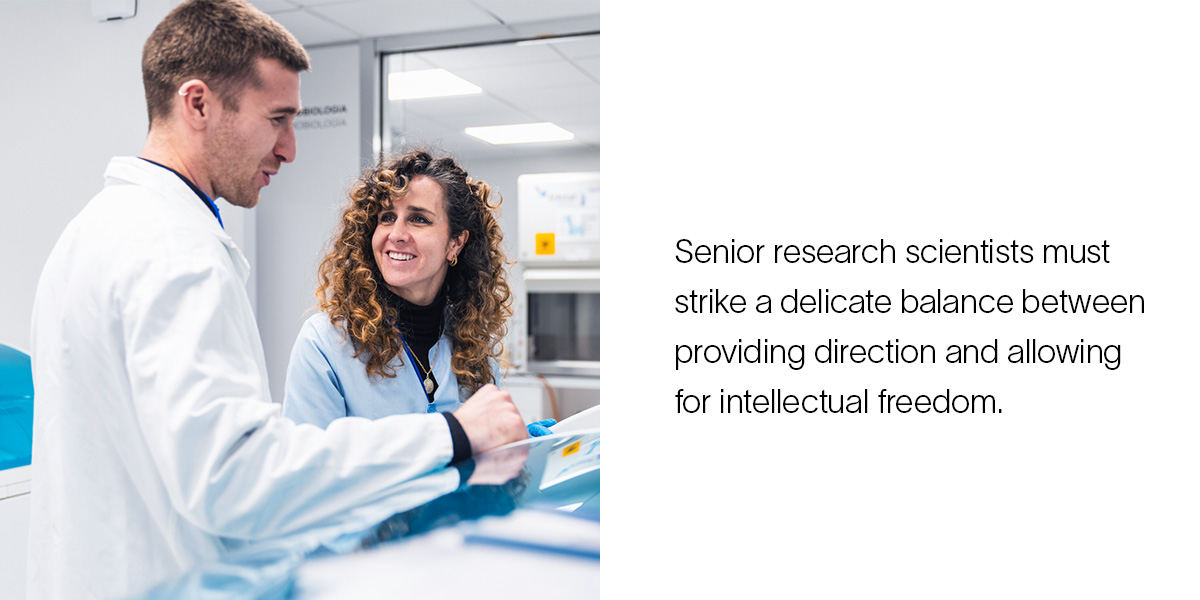
Leading a research team requires specialized skills. Senior research scientists must strike a delicate balance between providing direction and allowing for intellectual freedom. They should cultivate an environment where each team member feels valued and comfortable contributing their best work, even if that means taking risks. Some of their primary leadership responsibilities include:
- Collaborating with other professionals on groundbreaking projects.
- Coordinating fieldwork.
- Mentoring, supervising and supporting junior staff.
Within Danaher, senior research scientists are encouraged to mentor both formally and through collaborative project teams, reflecting our commitment to developing talent from within. Many of our associates share their growth journeys on our associate stories page.
Innovate and develop solutions
A senior research scientist’s job extends beyond research. As innovators and drivers of progress, they transform complex scientific discoveries into practical solutions that enrich lives. They combine their expertise and creativity to design new products, technologies and processes that could transform their industry and society.
Share research findings
The senior scientist must also share the team’s findings with the public and the scientific community. However, their role extends beyond delivering information. They must also highlight how the research impacts their field and their communities. They write research papers that describe the study’s implications and deliver presentations and seminars.
Senior research scientists also review and evaluate other scientists’ work. These passionate and dedicated individuals work across many industries and specializations, pioneering solutions in biotechnology, medical research, life sciences and many other applications.
They face many career challenges, including policy changes and securing funding. Like reaching the top of any field, becoming a senior research scientist requires considerable commitment and dedication.
Consult and advise on research

As a trusted expert in their field, a senior research scientist often advises industry leaders on research, using their past findings and experience to inform decisions, practices and policies affecting their field. They must constantly expand and update their research skills and keep up with the latest industry developments to effectively fulfill this role.
What do Research Scientists do at Danaher?
At Danaher, senior research scientists play an instrumental role in leading research initiatives across our family of operating companies. Guided by the Danaher Business System (DBS), these leaders foster cross-functional collaboration and accelerate the delivery of impactful solutions to markets worldwide.
Take a look at some research scientist roles at Danaher:
- Research Scientist III: The Research Scientist III works on our Integrated DNA Technologies team to develop new products, support on market Next Generation Sequencing and present experimental demonstrations.
- Research Associate: Abcam’s Research Associate performs antibody conjugation and subsequent purification. In this role, team members will prepare buffers and reagents, contribute to process improvements, and ensure accurate documentation in line with industry standards.
- Senior Research Data Scientist: The Senior Research Data Scientist aids in the advancement of future therapeutics from discovery to delivery. This team member builds hybrid models to simulate and predict process behavior, explores emerging AI technologies, and analyzes complex spectral datasets.
What skills do Senior Research Scientists need?
Senior research scientists often make a meaningful difference to the scientific community and change millions of lives. They need many hard and soft skills to balance their roles as leaders and scientists:
- Excellent communication: A senior research scientist gathers funding for various projects, provides expert opinions and collaborates with other specialists. Strong written and verbal communication skills enable them to gather insights and consider different perspectives on results. At Danaher, scientists regularly collaborate across business units and geographies, making strong communication vital to sharing insights and accelerating innovation.
- Attention to detail: A senior research scientist is responsible for the accuracy and effectiveness of the studies they lead. Attention to detail helps them manage all the variables of an experiment. DBS reinforces Danaher’s commitment to quality, empowering researchers to uphold rigorous standards in every stage of discovery.
- Patience: Many studies take months or even years to achieve usable results. Some senior research scientists may work on the same projects for decades. Patience, focus and consistency help anyone looking to advance into a senior research position.
- Technical knowledge: Science intertwines with information technology (IT). Technical skills, then, assist with turning scientific data into charts and funding proposals. Senior research scientists may also create tests and experiments using advanced software.
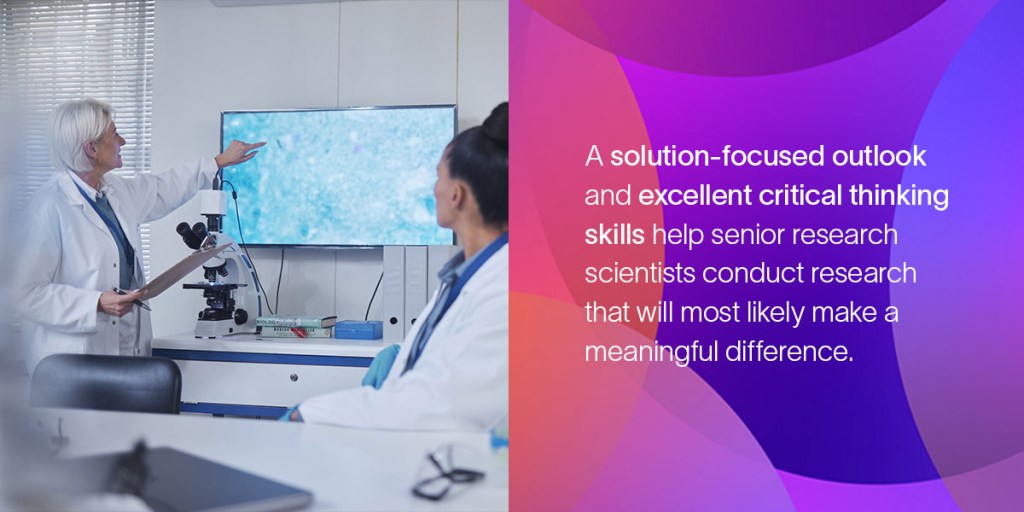
- Problem-solving: Senior research scientists may be tasked with solving some of the world’s most pressing medical and biotechnology problems. A solution-focused outlook and excellent critical-thinking skills help them conduct research that is likely to make a meaningful difference.
- Analytical skills: A senior research scientist’s primary responsibility is to transform raw data into practical information they can use to change lives. Analyzing data allows them to condense information and report it easily in research papers and other documents.
- Time management: One of a senior research scientist’s most important tasks involves planning and defining timelines for research projects and scientific studies. As funding often depends on these time estimates, they must be able to predict the timeline and stick to it wherever possible to ensure accurate and consistent results.
- Teamwork and interpersonal skills: Scientists often work alongside other experts, collaborating and bringing their specific expertise to various projects. Senior research scientists should have excellent interpersonal skills to collaborate effectively with their peers and mentor junior scientists.
Education and experience requirements
Advancing to a career as a senior research scientist requires years of education and a track record of successful projects. Education requirements for senior research scientists include a bachelor’s degree in a related field, such as chemistry, physics, mathematics or statistics. Most applicants have a master’s degree or a doctorate in their chosen discipline, which allows them to gain more in-depth knowledge and expertise in a specific field. However, it’s possible to become a senior research scientist without a PhD.
Senior research scientists must also have extensive research experience in their chosen field. Over time, research experience helps them develop the necessary skills, such as data analysis, critical thinking and problem-solving skills. They also create a robust research portfolio by working as a research assistant, university fellow or associate.

Science, technology, engineering and mathematics (STEM) fields progress rapidly as pioneers in the field discover new and exciting technologies. Aspiring senior research scientists should devote time to continuous learning and stay up to date with the latest trends and technologies. Additional certifications and specialized training enhance candidates’ qualifications, making them a better fit for the senior research scientist role.
At Danaher, educational credentials are just the start. Our senior research scientists often come from diverse academic and industry backgrounds, united by their passion for pioneering scientific breakthroughs. Many associates join us with advanced STEM degrees, while others use Danaher’s extensive professional development resources to continually sharpen their expertise.
How to transition from academia to industry
Shifting from academia to an industry career can broaden professional horizons. The process involves adapting to different work cultures, expectations and criteria for advancement.
Ultimately, industry employers tend to prioritize demonstrated innovations, tangible results and collaborative experience over titles or purely academic achievements. Those looking to transition should:
- Translate achievements: Success in this transition often involves reframing academic achievements to highlight practical impact, such as delivering results in problem-solving environments outside of academia.
- Build industry-relevant skills: Building industry-relevant skills, such as proficiency in data analysis tools and product development, can make candidates stand out.
- Network beyond academia: Networking also plays a crucial role — connections established through professional organizations or informational interviews often open doors to new career tracks.
- Gain experience outside the lab: Experience outside of traditional academic research, such as internships, demonstrates adaptability, which is an asset in industry roles.
- Tailor resumes and interviewing styles: Resumes tailored for industry are typically concise, outcome-focused and free of academic jargon.
Many Danaher associates have successfully transitioned from academic labs to impactful industry roles. Through our on-the-job learning culture and values-driven leadership development, scientists new to Danaher gain exposure to diverse research projects and the chance to contribute directly to global challenges.
Developing a research niche
Many senior research scientists have a specific niche — the area or topic they focus on and feel passionate about. Aspiring senior scientists should consider developing their niche to establish a solid reputation and gain credibility in their fields. Having a niche also helps to attract funding and exciting collaboration opportunities.
Anyone aiming to become a senior research scientist can develop a niche by identifying a gap or challenge in the existing literature or status quo. They take risks and push boundaries by conducting unique research. Once they have a potential solution, they should share it via publications and presentations.
Candidates should start by exploring what ignites their passions within their field. From there, they can narrow their focus and build expertise through networking and publishing.
Building a strong professional network
Networking with peers, industry professionals and potential collaborators benefits senior research scientist candidates. They should proactively attend and contribute to conferences, workshops and seminars to engage with experts and their peers. They should also join professional associations and societies to access valuable resources and opportunities in their fields.
Aspiring senior scientists should also leverage online platforms like ResearchGate and LinkedIn to connect with peers, share their discoveries and stay abreast of the latest industry trends. Cultivating these connections opens new insights, collaborations and potential career opportunities.
Maintaining relationships with former colleagues and mentors also presents an opportunity for career advancement. As research scientists advance their careers, they can rely on these connections for positive reviews, references and new collaboration opportunities.

Seeking mentorship and feedback
Senior research scientist candidates should focus on networking with peers who have more experience in their fields. Experiences and established researchers will provide the feedback necessary to grow. They can look to current or previous research teams, institutions or professional networks.
Receiving guidance from people already established in senior research scientist positions provides candidates with firsthand advice, support and opportunities to sharpen their research skills. A positive mentor can boost any candidate’s career development and professional growth, and mentors can lend their skills and expertise to the candidate’s existing research.
Developing leadership and management skills
Moving into a senior research scientist role requires candidates to strategize and lead teams. Candidates will move into leadership positions, taking responsibility for decision-making, project management and other leadership tasks.
Research scientists looking to advance their careers should focus on sharpening their leadership and management skills. They should seek leadership opportunities that demonstrate their passion, skills and impact while allowing them to showcase their ability to inspire and guide others.
Any opportunity to take on a leadership role gives candidates the responsibility to set research goals, coordinate strategies and prioritize resources. They also have the opportunity to provide guidance and feedback to other team members, which requires soft skills like conflict resolution and communication.
Candidates can build their leadership skills by volunteering for mentorship opportunities and at scientific events. Slowly, they gain the skills and credibility to take on increasingly significant management roles.
Showcasing research expertise and achievements
Even the most skilled and experienced candidate needs to showcase their achievements. Candidates can build a robust research portfolio and showcase their research skills with the following tips:
- Narrow down project selections: Candidates should highlight any research experience and projects to showcase their unique approach, technical expertise and critical thinking skills. Each highlighted project should include a brief description of the research question, the project’s purpose and its outcome. Candidates should highlight projects that align with their goal of becoming a senior research scientist and demonstrate how their research addresses real-world challenges.
- Accentuate methods and tools: Candidates should highlight and explain the methods and tools they used or learned across various projects.
- Highlight the impact: Candidates must measure and communicate the value of their research. Whenever possible, they should quantify each project’s impact using relevant numbers and metrics.
- Demonstrate soft skills: Advancing to the senior research scientist role requires more than understanding hard data. Candidates should also showcase the soft skills they used and developed during their research to demonstrate their ability to lead a team.
- Include other achievements: Candidates should list any publications or conference presentations to strengthen their credentials. They should also mention their continuous learning certifications to demonstrate their commitment to staying up to date in their field.
Navigating the promotion process
Once candidates have gathered the necessary qualifications and experience, they must know how to apply for a senior scientist position. They can take several avenues, from seeking advancement opportunities within their organization to exploring external opportunities. The following tips can help senior research scientist candidates successfully navigate the process.

Quantify project impact
The first step for candidates is to provide evidence of their scientific contributions. Applicants should document their achievements and quantify their impact with the relevant metrics. They must also highlight the skills and competencies they have developed to prepare them for the next level, including leadership, problem-solving, critical thinking and communication.
The goal should be to demonstrate the candidate’s value to each project. Candidates should also align their aspirations with the organizational culture they’re applying to, showing recruiters that their goals align with the company’s broader aspirations.
Offer something unique
Instead of focusing on the impact they can make today, senior research scientist candidates should consider how they can grow with their potential organizations in the future. Within their current organizations, candidates can identify areas for improvement and leverage their skills to position themselves as leaders.
Establish a strong reputation
The more people value a candidate’s abilities, the better positioned they are to assume senior roles. They should attempt to diversify projects and work with as many different people as possible, demonstrating professional independence and gaining exposure to organizational perspectives.
Seek feedback on improvement areas
Current research scientist associates have a great support system of supervisors who can discuss their goals for advancing to senior research scientist positions. Supervisors and other team members can give candidates constructive criticism and honest feedback, allowing them to pinpoint areas for improvement.
How to prepare for a Senior Research Scientist interview
Interviewing for high-level positions often requires a slightly different approach. Once candidates have secured an interview, they should take their time to prepare. They should be able to communicate their research skills and critical thinking to the interviewer and explain how their work can advance the organization’s objectives.

Some tips and tricks for preparing for a senior research scientist interview include:
- Understanding the organization: Candidates should investigate and understand the scope of their current research projects. Understanding the organization’s focus can help candidates connect their expertise with their work.
- Reviewing the research: Candidates can expect to discuss their previous projects in detail, including outcomes and methodologies. They should also be able to connect their past research to their desired position.
- Expecting technical questions: Candidates should brush up on key concepts and recent innovations in their field of study and come to interviews prepared to analyze data and demonstrate their problem-solving skills.
- Focusing on the impact: Senior research scientists can make a meaningful difference in people’s lives with their research. Candidates interviewing for these positions should consider how their research can impact the organization and their communities.
- Preparing to present: Some interviewers expect candidates to present their research findings, which provides an opportunity to showcase their communication skills. Candidates can practice delivering engaging and concise presentations for general and technical audiences.
- Highlighting soft skills: In addition to technical and scientific questions, candidates should prepare to answer questions about their teamwork, leadership and problem-solving capabilities.
- Preparing questions for the interviewer: Like in any other interview, candidates should have a list of insightful questions that demonstrate their interest in making a difference in their new role.
Interviewing for a position at Danaher
Danaher strongly encourages senior research scientist candidates to explore our operating companies, understand our mission to drive life-changing innovation and review recent associate stories. Interviewers are particularly interested in how a candidate’s skills can contribute to Danaher’s culture of continuous improvement and scientific excellence.
Take a closer look at our recruitment process:
- Application: Candidates submit a resume. They can track their candidacy status and apply to additional roles through their candidate homepage.
- Phone screen: Our team will reach out to selected candidates. We’ll schedule an initial phone screen, which typically lasts between 30 and 45 minutes. During this conversation, our interviewers will ask more questions about a candidate’s background and provide more information on the company.
- Interviews: During the interview stage, candidates will meet hiring team members through in-person or online conversations. Candidates usually meet with three to seven team members.
- Offers: Candidates we select for a role will receive both a written and a verbal offer with key details. Candidates who accept our offer will start their first day three to four weeks after acceptance.
Comparing the various educational pathways
Choosing the right educational pathway is a critical step for aspiring research scientists. Each option shapes skills, experience and career possibilities. Understanding the trade-offs can help professionals make informed decisions as they plan their professional journey.
- B.S. to job: This pathway offers the fastest entry into the job market, but often offers fewer opportunities for career advancement. Although it’s possible to reach a senior position with only a B.S. and experience, many leadership roles will require a higher degree of education.
- B.S. to M.S. to job: At this level, scientists can develop specialized skills and knowledge to advance their careers. This pathway requires more time in education, but can open the door for more senior roles later.
- B.S. to PhD to job: A PhD remains the standard for most senior roles. This pathway requires a lengthy time commitment, often demanding five to eight years of education and experience post-B.S. However, with this pathway comes deeper expertise, more autonomy and higher pay later.
- B.S. to PhD to postdoc: Postdocs often serve as a bridge between graduate studies and a permanent career. Taking this path involves developing advanced skills and gaining independence in a specialized field. These professionals dedicate the most time to education and academia roles, but are most likely to achieve senior leadership roles.
A realistic timeframe for the Research Scientist career path
How long it takes to become a senior research scientist varies. The fastest paths to a senior role involve more than degrees — successful professionals build a portfolio of impactful work and leadership skills. Depending on a scientist’s educational pathway and sector, professionals can achieve their goals in different ways:
- PhD track: Typical progression paths indicate that research scientists need five to eight years of post-PhD experience to advance to senior positions. Often, the scientist will have a postdoc and relevant industry or government experience. However, publishing high-impact works, leading successful projects, networking and joining fast-growth companies can accelerate the path.
- M.S. track: Professionals may achieve leadership roles 10 to 15 years after receiving an M.S. M.S. holders tend to start in technician or associate scientist roles and must demonstrate exceptional performance or management skills to reach senior status. Taking on leadership roles, broadening skill sets and being willing to relocate can shorten the timeline.
Research Scientist vs. Senior Research Scientist
A research scientist typically focuses on conducting experiments, collecting and analyzing data, and supporting broader team projects, with project leaders often guiding daily responsibilities. At this stage, the primary emphasis is on developing technical expertise, learning new methods and contributing to the team’s research objectives. In contrast, a senior research scientist moves beyond technical execution into a leadership role.
Key differences include:
- Responsibilities: Senior research scientists design research projects from start to finish, set scientific strategy and often serve as technical leads. They may supervise junior scientists and manage laboratory resources.
- Autonomy: While research scientists typically operate under direct supervision, senior research scientists enjoy significant independence. They make key decisions about project direction, resource allocation and problem-solving.
- Expectations: Senior research scientists are expected to drive innovation and communicate results to both technical and nontechnical stakeholders, typically while leading a team. They contribute to setting research agendas and help shape strategic priorities for their teams or organizations.
Academic vs. industry expectations: how important are patents?
In academia, impact is most often measured by publications, grant funding and academic collaborations. Patents are valued, but are rarely the main metric for career advancement — except in tech transfer or entrepreneurial tracks. Additionally, one study indicates that academic researchers see little economic gain from patents because royalties often accrue to their home institutions.
However, scientists who produce patents and publications may be more productive and exert greater research influence. Another study highlights how patenting boosts research and shows that even early-career patents can have considerable impacts on productivity.
In industry positions, patents are highly significant. Companies protect innovations via intellectual property, and a scientist’s ability to produce patentable discoveries or contribute to company portfolios can strongly impact their career trajectory and compensation. Patents show that an individual can create new knowledge and commercially valuable solutions — a key differentiator in performance reviews and promotions.
What it means to be a Senior Research Scientist at Danaher
Many senior research scientists live to innovate and lead solutions that change lives. At Danaher, we tackle some of the most complex global challenges while keeping our impact at the heart of our culture.

Danaher brings expertise, services and technologies together to accelerate the commercialization of life-changing therapies, technology and medications. In addition, our teams have access to a proven system for success called the Danaher Business System. It’s our shared language and a place we look to for daily inspiration.
Joining the Danaher team means working alongside top leaders in their fields. They thrive on collaboration and have a deep passion for supporting others’ success. Together, we experience the impact of our hard work and celebrate as we drive innovation that makes the world a better place. Growth is integral to our culture and values, and our leaders remain committed to helping their teams achieve their potential, whether by mastering their current roles or advancing in their careers to become senior research scientists.
At Danaher, research professionals can advance their careers through various opportunities, including:
- Biotechnology with Cytiva: Cytiva accelerates and commercializes medicine and healthcare solutions. Here, professionals contribute to groundbreaking advancements in biotechnology, working on solutions that enable the discovery, development and manufacture of lifesaving therapies. Opportunities include roles in bioprocessing, cell therapy and product development.
- Life sciences with Pall Corporation: Within Pall Corporation, scientists can explore careers focused on filtration, separation and purification technologies essential to life sciences and laboratory research. Positions often emphasize technical innovation and problem-solving.
- Diagnostics with Beckman Coulter: At Beckman Coulter, research and development roles are at the forefront of diagnostics, transforming how diseases are detected and managed. Employees are involved in advancing automation, laboratory technology and diagnostic assays that impact patient outcomes globally.
Realize your career goals with Danaher

If you want to grow and learn in a career where you can take risks and realize your potential, Danaher is an excellent fit for you. The Danaher culture encourages you to push the boundaries of what’s possible, making a real-world impact you can see every day. As leaders in life sciences, biotechnology and diagnostics, we solve some of the world’s most complex challenges while helping our teams grow their knowledge and passions.
Get ready to unlock groundbreaking innovations with us. Explore our current job openings today!
Leave a Reply