Diagnostics and life sciences innovations are redefining the future of human health. Every day, advanced tools and technologies empower healthcare professionals to identify diseases with unprecedented speed and accuracy. These innovations include cutting-edge imaging machines, precise lab tests and smart software that can analyze medical data efficiently. For example, faster and more accurate tests can help identify infections at an early stage for timely intervention.
At the same time, life sciences innovation is accelerating the discovery and development of new therapeutics, vaccines and biopharmaceuticals. Advanced tools for drug discovery, bioprocessing and genomic medicine let researchers translate scientific breakthroughs into life-changing treatments faster than ever before.
Danaher focuses on life sciences and diagnostics innovation to improve human health to create breakthroughs in personalized medicine and more effective treatments. Learn more about the life science and diagnostics industry and how it’s making healthcare more accessible for everyone.
Table of Contents
- The Importance of Diagnostics and Life Sciences Innovation
- How Diagnostics and Life Sciences Innovation Is Transforming Human Health
- 7 Ways We Are Improving the Future of Human Health
- About the Diagnostics Innovation Movement at Danaher
- Innovation Is the New Core Skill Set for Diagnostics and Life Sciences Careers
- Join the Diagnostics and Life Sciences Innovation Movement at Danaher
The Importance of Diagnostics and Life Sciences Innovation
Diagnostics and life sciences make vital contributions to science and human health through continuous innovation.
Why Diagnostics Innovation Matters
Diagnostics innovation develops cutting-edge tools and technologies that analyze medical data and detect illnesses at their earliest stages. Early detection can prevent complications, reduce treatment costs and improve patient outcomes. Diagnostics play a vital role in various healthcare aspects, including prevention, screening, diagnosis and monitoring of diseases.
The key aspects of diagnostics include:
- Identification: Diagnostics confirm or exclude conditions, allowing for swift treatment plans and halting disease progression.
- Monitoring: After diagnosis, tests monitor treatment effectiveness and ensure optimal patient care.
- Prognosis: Diagnostics provide insights into disease progression and help predict patient outcomes by optimizing care pathways.
Diagnostics encompass in vitro and in vivo methods. They are essential for managing communicable and noncommunicable diseases, injuries and disabilities. Ensuring equitable access to quality diagnostics requires a comprehensive health-systems approach.
Diagnostics also involves ordering, interpreting and acting on tests appropriately while ensuring accuracy and optimizing resource use.
Why Life Sciences Innovation Matters
Life sciences innovation focuses on the discovery, development and manufacturing of new therapeutics and biopharmaceuticals. Key areas include:
- Drug discovery and development: Advanced life sciences platforms let researchers identify promising drug candidates, understand disease mechanisms and accelerate the path from laboratory discovery to clinical application. AI-powered drug design, high-throughput screening and human-relevant models like organoids reduce development time and improve success rates.
- Manufacturing: Innovative manufacturing technologies support efficient, scalable production of biopharmaceuticals, cell and gene therapies and vaccines. Continuous improvement in bioprocessing ensures that breakthrough treatments reach patients faster and more sustainably.
- Precision therapeutics: Life sciences innovation enables the development of targeted therapies based on genetic and molecular insights. This lets researchers design treatments tailored to specific patient populations or disease subtypes, improving efficacy and reducing side effects.
- Data integration: Life sciences platforms integrate research data, laboratory workflows and analytics to streamline drug development. Digital solutions help researchers manage complex data, collaborate across teams and make faster, more informed decisions.
How Diagnostics and Life Sciences Innovation Is Transforming Human Health
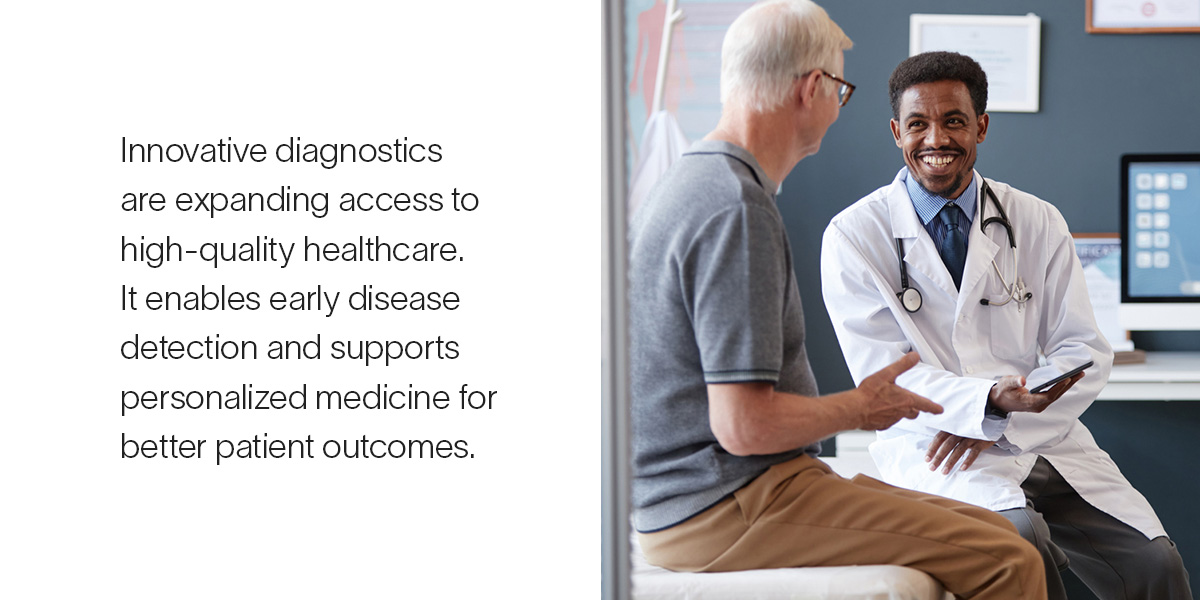
Diagnostics innovation is reshaping healthcare with far-reaching effects on patients, health providers and health systems.
Expanded Access and Equity
Innovative diagnostics now deliver high-quality healthcare to communities that previously lacked access. Point-of-care (POC) tests and home-based diagnostics allow patients in rural or underserved areas to receive timely testing without traveling to distant laboratories. This is especially crucial for managing chronic diseases, monitoring infectious outbreaks and supporting aging populations who may have mobility challenges.
Early Detection and Prevention
Modern diagnostics enable earlier detection of diseases such as cancer, diabetes and infectious diseases. Technologies like liquid biopsies can identify cancer markers in blood samples before symptoms appear, which helps with earlier intervention and better survival rates. Early diagnosis also helps prevent disease spread and reduces the risk of complications, further leading to improved public health outcomes.
Personalized and Precision Medicine
Advances in molecular and genetic testing are paving the way for personalized medicine. Diagnostics can now identify specific genetic mutations or biomarkers that enable healthcare providers to tailor treatments to individual patients. This approach increases treatment effectiveness, minimizes side effects and can even predict how a patient will respond to certain therapies.
In life sciences, these same molecular and genetic insights help researchers design precision therapeutics, accelerating the development of safer, more effective treatment options.
Accelerated Drug Development
Life sciences innovation reduces the time and cost of bringing new treatments to market. Advanced research tools, AI-powered drug design and human-relevant disease models enable researchers to identify promising candidates faster and predict clinical outcomes more accurately.
This acceleration is especially impactful for rare diseases, cancer therapies and emerging infectious diseases, where speed is sometimes a matter of life and death. By shortening development timelines, life sciences innovation also reduces the financial burden on healthcare systems and makes innovative treatments more accessible to patients globally.
Data Integration and Digital Health
The integration of diagnostics with digital health platforms and artificial intelligence (AI) is transforming how we collect, analyze and use data. Wearable devices and connected diagnostic tools can continuously monitor health metrics and alert patients and providers to potential issues in real time. AI algorithms can analyze vast amounts of diagnostic data to identify patterns and support faster, more accurate decision-making.
Outbreak Response and Public Health
Rapid diagnostics are essential during public health emergencies for identifying cases, tracking disease spread and guiding containment strategies. Innovations in test development, such as rapid antigen and molecular tests, have enabled large-scale screening and surveillance to help control outbreaks more effectively.
Economic and Systemic Benefits
With earlier and more accurate diagnoses, innovative diagnostics help reduce:
- Unnecessary treatments.
- Hospitalizations.
- Healthcare costs.
They also optimize resource use by ensuring that interventions are targeted and effective. It benefits patients while also strengthening the sustainability of healthcare systems.
7 Ways We Are Improving the Future of Human Health
Life sciences and diagnostics innovation offers numerous benefits for patients, clinicians and healthcare systems. Automation and digital integration reduce the administrative burden on clinicians, allowing them to focus more on patient care and less on manual processes. Advanced diagnostics also facilitate better communication and collaboration among healthcare teams since all providers have access to the same accurate and up-to-date information.
These case studies show how life sciences and diagnostic innovations are improving the future of human health.
1. Scaling Biopharmaceutical Production
Noah Weyrick is a scientist at Cytiva, a Danaher company specializing in bioprocessing and life sciences. During the COVID-19 pandemic, Noah’s work focused on cell culture and process development, which are essential steps in producing both biopharmaceuticals and diagnostic reagents at scale. His team’s efforts ensured that critical components for COVID-19 tests and treatments were manufactured efficiently and met high-quality standards.
The benefits from this process included:
- Patients had faster access to critical diagnostics and therapies during the pandemic, which will improve their chances of early detection and treatment.
- The company provided a reliable supply of high-quality diagnostic and therapeutic products that enabled clinicians to make timely, informed decisions about patient care.
- Healthcare systems could respond to public health emergencies by rapidly scaling up production and distribution of diagnostics to support system resilience and preparedness.
Noah’s work exemplifies how behind-the-scenes scientific expertise in bioprocessing and diagnostics innovation can directly support public health responses. These processes can make lifesaving diagnostics and therapies available faster during global health emergencies.
2. Digitalizing Pathology
Digital pathology is a field that is rapidly moving from traditional glass slides to digital images and AI-powered analysis. Companies like Leica Biosystems are developing platforms that digitize tissue samples and use AI to assist pathologists in diagnosing diseases, such as cancer.
The company’s digital pathology platforms allow for high-resolution image analysis, remote collaboration and applying AI to identify disease patterns more quickly and accurately.
The shift from traditional glass slides to digital workflows has the following advantages:
- Quicker and more accurate diagnoses for complex diseases
- Earlier interventions and improved outcomes
- Reduction in diagnostic errors
- Consultation with global peers
- Increased efficiency and scalability in pathology services
- Reduced turnaround times
Digital pathology is a game-changer for cancer care and other complex diseases. With AI, it is revolutionizing diagnostics by making expert analysis more accessible and allowing doctors to serve more patients with fewer resources.
3. Advancing Molecular Devices
This story follows Zhiqiang Zhang, who started as an intern at Molecular Devices — a Danaher company — and became a systems engineer. He contributed to the development and launch of the SpectraMax® Mini Multi-Mode Microplate Reader. This innovative diagnostic tool supports researchers by providing reliable, versatile and user-friendly laboratory testing capabilities. The product won Danaher China’s New Product Gold Award, highlighting its impact and innovation.
Improved laboratory testing leads to more accurate and timely diagnoses and better-informed treatment plans. These types of innovations enhance the quality and efficiency of diagnostic testing and improve laboratory productivity and throughput.
This case shows how Danaher nurtures talent and innovation by empowering young engineers to make a real difference in diagnostics technology.
4. Supporting Abcam’s Purpose
Abcam — also a Danaher company — is a global leader in supplying antibodies and reagents for life sciences research. Abcam’s mission-driven culture inspires its staff to contribute to scientific breakthroughs. Their products enable researchers to develop new diagnostic tests, advance life sciences research and better understand disease mechanisms.
The company’s commitment to quality and purpose-driven innovation helps accelerate the creation of more sensitive and specific diagnostic tools that ultimately improve disease diagnosis and patient outcomes. For healthcare systems, it means an enhanced pipeline for diagnostics and support in ongoing improvements in disease surveillance, research and public health interventions.
Abcam’s commitment to quality and innovation accelerates the development of new diagnostics that help clinicians and researchers detect diseases earlier and more accurately.
5. Prioritizing a Continuous Improvement Culture
The Danaher Business System (DBS) is Danaher’s unique approach to continuous improvement — a culture that empowers every associate to solve problems, innovate and drive operational excellence. Through daily management, visual controls and a relentless focus on customer needs, the staff streamlines processes, reduces waste and accelerates the delivery of high-quality diagnostic solutions.
Clinicians gain access to diagnostics that are continually refined for accuracy, usability and speed to support their decision-making. Healthcare systems experience increased efficiency, reduced costs and improved scalability in diagnostic services due to ongoing process optimization.
Danaher ensures that its products are consistently reliable, efficient and responsive to evolving healthcare needs by embedding continuous improvement into every aspect of diagnostics development and delivery. This culture of innovation leads to faster product development, high-quality diagnostics and the ability to adapt quickly to new health challenges.
6. Transforming Patient Care With Diagnostics
Danaher Diagnostics focuses on enabling precision medicine through advanced diagnostics. Our mission is to ensure that patients receive the correct treatment at the ideal time by developing tests that can identify specific disease markers and guide therapy choices. Danaher helps to reduce trial-and-error in treatment, minimize side effects and improve overall outcomes through these benefits:
- Patients receive more personalized and effective treatments with better outcomes and fewer unnecessary interventions.
- Clinicians make more confident and precise treatment decisions with actionable diagnostic information.
- Healthcare systems benefit from optimized resource use, reduced costs associated with ineffective treatments and improved patient satisfaction.
These approaches are especially impactful in areas like oncology, where targeted therapies can make a significant difference.
7. Advancing Oncology Diagnostics
Danaher uses digital pathology, AI and molecular testing to improve the detection, classification and monitoring of cancer.
Multidisciplinary collaboration with integrated technologies helps address the complexities of cancer diagnosis and treatment. These innovations in oncology diagnostics enable earlier and more accurate discovery. This, in turn, supports the development of personalized treatment plans and facilitates ongoing monitoring for disease recurrence.
Using AI and digital tools also allows for faster analysis and broader access to expert pathology services. Major benefits of these advanced diagnostics include improved efficiency, reduced diagnostic errors and the ability to deliver high-quality cancer care at scale.
About the Diagnostics Innovation Movement at Danaher
Danaher’s diagnostics innovation movement and culture are built on the DBS, which drives continuous improvement, operational excellence and a relentless focus on customer needs.
Associates at every level are empowered to identify challenges, propose solutions and implement changes that enhance product quality, efficiency and impact. This culture of curiosity and improvement is supported by:
- Cross-functional collaboration.
- Investment in cutting-edge technologies.
- A commitment to learning and growth.
Danaher actively invites innovators, researchers, startups and business developers to join its mission. The company’s global reach and collaborative mindset create opportunities for individuals and organizations in the innovation ecosystem to:
- Partner on research and development: Work with Danaher’s teams to codevelop new diagnostic solutions and bring them to market.
- Join a mission-driven organization: Be part of a company where every role contributes to saving lives and improving health outcomes.
- Access career development: Danaher invests in its people by offering mentorship, training and opportunities for advancement across its global network.
- Drive real-world impact: Innovators at Danaher see their ideas turn into products that clinicians use for patients globally to make a tangible difference in healthcare.
Innovation Is the New Core Skill Set for Diagnostics and Life Sciences Careers
Innovation is more than a buzzword — it’s a core skill set for anyone pursuing a career in diagnostics and life sciences. As new technologies and approaches transform the industry, professionals who embrace innovation are best positioned to drive meaningful change and advance human health.
Along with technical expertise, diagnostics calls for creative problem-solving, adaptability, digital literacy and a passion for continuous learning. To develop new solutions that improve patient outcomes and healthcare systems, those working in diagnostics need to think outside the box and collaborate across different disciplines.
In life sciences, this means understanding drug discovery workflows, bioprocessing challenges and the regulatory landscape for therapeutics. Professionals who combine technical expertise with creative problem-solving and a commitment to continuous learning are best positioned to drive breakthroughs in both diagnostics and life sciences.
At Danaher, we recognize that innovation is at the heart of diagnostic and life sciences excellence. We actively seek out individuals who are curious, forward-thinking and eager to make a real-world impact. Our culture empowers associates at every level to propose new ideas, experiment with emerging technologies and contribute to breakthroughs that shape the future of healthcare.
Join the Diagnostics and Life Sciences Innovation Movement at Danaher
Danaher is a global leader in diagnostics and life sciences innovation, dedicated to accelerating the power of science and technology to improve human health. Our approach to innovation is comprehensive and collaborative, making it a central force in the global innovation ecosystem.
Be part of a team that is at the forefront of medical innovation. Explore our diagnostics and life sciences careers today.