
For professionals looking to embrace a role that shapes the future of innovation, product engineering is an ideal path. Product engineers are critical to cutting-edge product development practices across industries, from biotechnology and diagnostics to life sciences and industrial solutions.
Explore the contributions product engineers can make at top companies and what to expect when advancing in this field. This product engineer career guide explains how product engineering roles advance with experience, the key skills product engineers need for career progress, the types of positions a product engineer can work in, and how you can enjoy a rewarding career as a product engineer at Danaher.
Table of Contents
- 1. What Is a Product Engineer?
- 2. Typical Product Engineer Job Duties and Responsibilities
- 3. Types of Product Engineers
- 4. Common Job Requirements for Product Engineers
- 5. Product Engineer Salary and Earnings Potential
- 6. Career Growth Opportunities as a Product Engineer
- 7. Innovate Daily as a Danaher Product Engineer
- 8. What to Expect as a Product Engineer at Danaher
- 9. Explore Product Engineer Roles at Danaher Today
What Is a Product Engineer?
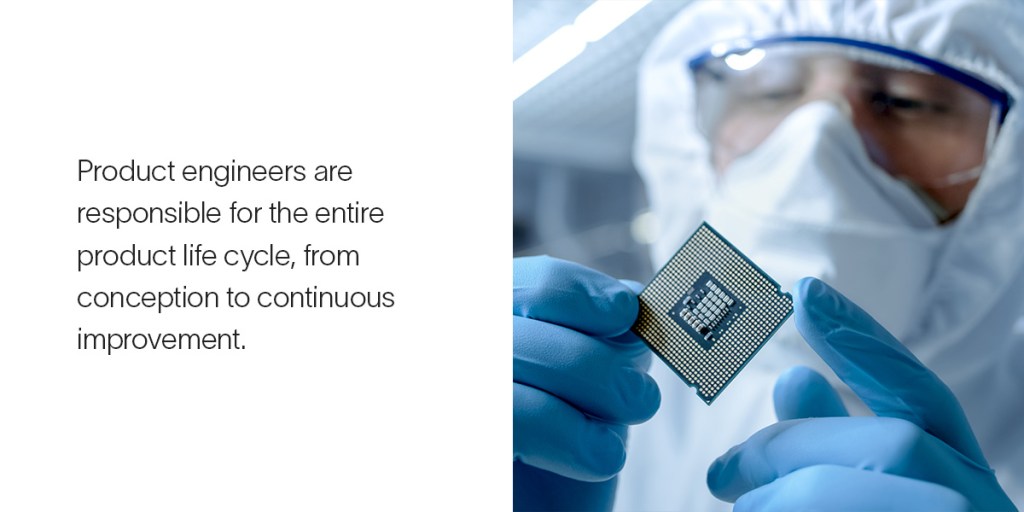
[Product engineers are responsible for the entire product life cycle, from conception to continuous improvement.]
A product engineer is a skilled professional responsible for the entire life cycle of a product, from conception and design to development, launch and continuous improvement. The role involves a blend of technical expertise, strategic thinking and a deep understanding of user needs and market dynamics. Depending on their employer’s products, their work may span software, hardware and mechanical engineering.
Product engineers ensure products are technically sound, user-friendly and aligned with customer needs and business objectives. A successful product engineer commits to continuous innovation and user-centric design, helping organizations optimize their offerings. A product engineer’s job scope can include varying responsibilities depending on the employer’s mission, all aimed at creating the most impactful solutions for customers.
How Product Engineer Roles Evolve With Experience
Early in their careers, product engineers focus on mastering technical skills, contributing to specific features and ensuring code quality or design integrity. But professionals with five or more years in the field can make higher-level, higher-value contributions that are both more challenging and more rewarding. At this point, the emphasis shifts from building components to shaping entire product ecosystems. This demands a broader perspective that encompasses market dynamics, user psychology and long-term strategic planning.
Seasoned product engineers become architects of solutions, mentors to emerging talent and key influencers in product direction. They anticipate future trends, identify opportunities for innovation and guide cross-functional teams through the process of bringing a product from concept to market. This requires technical prowess and exceptional leadership skills.
The Importance of Product Engineers
[Product engineers provide strategic insight, technical leadership and mentorship that drives innovation.]
Product engineers are crucial to any organization striving for sustained innovation and market leadership, with key contributions including:
- Driving innovation: Product engineers are at the forefront of exploring new technologies and methodologies, identifying how these can make groundbreaking products possible and helping their companies maintain a competitive edge.
- Strategic insight: Product engineers connect technical possibilities with market needs, translating complex ideas into viable product strategies. Advanced product engineers can foresee challenges and opportunities that less experienced team members might miss.
- Technical leadership: With years of hands-on experience, seasoned product engineers provide invaluable technical guidance, setting best practices, making critical architectural decisions and ensuring product scalability. They’re go-to experts for complex technical problems.
- Mentorship and development: Experienced product engineers nurture the next generation of talent, sharing their knowledge and fostering a culture of continuous learning and excellence within engineering teams.
- Risk mitigation: Extensive experience lets product engineers identify potential product risks early in the development cycle. They can recommend strategies to mitigate these risks before they impact project timelines or product quality.
Typical Product Engineer Job Duties and Responsibilities

[Lasting career success as a product engineer depends on excellence in strategic product development, leadership, collaboration and innovation.]
Product engineer job descriptions vary depending on the industry, company and products. The following are common daily responsibilities for product engineers.
Strategic Product Development
At this level, product engineers are deeply involved in the “what” and “why” of product development — not just the “how.” Duties include:
- Defining product requirements: Product engineers collaborate with product managers and stakeholders to translate high-level business objectives and user needs into technical specifications.
- Architectural design: They lead the design of scalable and maintainable product architectures, choosing technology stacks, system integrations and infrastructure.
- Technical feasibility assessment: They evaluate the technical feasibility of new product ideas and features. These engineers provide realistic estimates for development efforts and identify potential technical challenges.
- Roadmap contribution: Product engineers contribute to the product roadmap, influencing prioritization based on technical insights, resource availability and strategic goals.
Technical Leadership and Mentorship
Experienced product engineers become technical authorities and guides for their teams, adding value by:
- Guiding less experienced team members, fostering their professional growth and skill development.
- Establishing and enforcing best practices for coding, testing, documentation and deployment to ensure consistent, high-quality engineering results.
- Conducting thorough code reviews, offering constructive feedback and ensuring adherence to architectural guidelines and quality standards.
- Diagnosing and resolving complex technical problems that may span multiple systems or components.
Cross-Functional Collaboration
The role demands strong communication and collaboration skills to align teams around a shared product vision. Responsibilities include:
- Stakeholder alignment: Product engineers work with product management, design, marketing, sales and other departments toward a unified understanding of product goals.
- Communicating technical concepts: They translate complex technical information into clear language for non-technical audiences.
- Advocating for technical needs: They represent the engineering perspective in product discussions, advocating for necessary technical investments and ensuring product decisions consider long-term technical health.
- User feedback integration: They collaborate with UX researchers and product managers to understand user feedback and integrate insights into product improvements and new feature development.
Innovation and Continuous Improvement
Driving innovation and building a culture of continuous improvement are marks of excellence in a product engineer. Growth-minded product engineers will:
- Explore emerging technologies and methods to identify product enhancement opportunities.
- Seek ways to improve development processes, increase efficiency and reduce technical debt within the engineering team.
- Lead initiatives for rapid prototyping and experimentation to validate new ideas and gather early feedback.
- Focus on optimizing product performance, scalability and reliability to deliver an exceptional user experience.
Types of Product Engineers

[Product engineers can choose from a wide range of rewarding positions to suit their interests and goals.]
Product engineers may find themselves in roles with several different titles and overlapping responsibilities, depending on the company’s needs and organizational structure. Experienced product engineers seeking new challenges can look for opportunities like:
- Senior product engineer: This role often involves leading complex projects, mentoring junior engineers and taking ownership of critical product components. A senior product engineer’s job description requires expertise in their domain to solve the most challenging technical problems and guide architectural decisions.
- Lead product engineer: A lead product engineer’s job description shifts further into leadership. They often oversee a small team or a specific product area. Responsibilities include technical strategy, resource allocation and ensuring alignment with broader product goals.
- Principal product engineer: This is a highly influential individual contributor role, often reserved for those with deep expertise and a track record of innovation. Principal product engineers drive technical excellence, define best practices and act as thought leaders within the organization, often working on initiatives that impact multiple products or teams.
- Technical architect: A technical architect defines the overall technical structure of products and systems. This role requires a rich grasp of technologies and the ability to make high-level decisions that ensure robust system design and scalability.
- Product security engineer: This specialized role focuses on integrating security throughout the product life cycle, from design to deployment. Product security engineers lead initiatives to implement security best practices, identify and remediate vulnerabilities and design secure architectures for complex software and hardware products.
- Product specialist: Often a market-facing role, a product specialist provides technical-scientific support to commercial teams, manages product life cycle activities and drives demand generation for specific products. They conduct product training, gather market insights from customers and contribute to strategic planning and go-to-market strategies, bridging the gap between technical features and market needs.
- Product manager: A natural progression for many product engineers, this role shifts the focus beyond how to build products to what products to build and why. Product managers define the product roadmap, gather market intelligence and prioritize features, collaborating with engineering, design and marketing teams. An engineering background gives product managers an invaluable perspective on feasibility and technical debt.
- Global product manager: This strategic role oversees the growth, management and reporting for assigned product lines across international markets. Global product managers lead new product development initiatives, execute product life cycle management and drive market expansion strategies.
Common Job Requirements for Product Engineers
From professionals pivoting into their first product engineer role to those advancing after years of experience in the field, understanding the requirements for a product engineer role can help ensure a great fit. Discover what employers look for when hiring product engineers below.
Education and Credentials
Common requirements for product engineer roles include:
- A bachelor’s degree in engineering
- A master’s degree in engineering or business administration for high-level positions
- A portfolio showing successful product development projects and contributions
Key Skills

[Software development, problem-solving, market analysis and leadership are key skills for career growth in product engineering.]
Product engineers need a skill set that blends technical expertise with strong interpersonal and strategic abilities. These skills include:
- Technical proficiency: Product engineering requires a firm comprehension of relevant programming languages, software development methodologies, hardware design principles or manufacturing processes, depending on the product domain.
- Problem-solving: These engineers need exceptional analytical and problem-solving skills to identify complex issues, analyze root causes and develop innovative solutions.
- Communication: It takes excellent communication skills to articulate technical concepts to diverse audiences, from engineers to business stakeholders.
- Collaboration: Product engineers must work effectively in cross-functional teams, supporting collaboration and driving consensus.
- Product and market analysis: A keen understanding of user needs, market trends and business objectives is crucial to guide product decisions and strategy.
- Leadership: Advancing as a product engineer requires the capacity to lead projects, mentor team members and influence product direction without direct authority.
Experience
Professionals with prior career experience in software development, project engineering, product development or a related field often succeed in product engineering roles. This foundational experience provides the technical depth necessary to excel in product engineering.
The highest-paying product engineering positions typically require five or more years of experience in product engineering, software development, hardware engineering, or a closely related field. Recruiters for these roles often look for demonstrated experience leading product development initiatives from concept to launch.
A common career path runs from software development into a product engineering role, where fluency in code is valuable for assessing feasibility and risks, estimating development timelines and architecting solutions to technical challenges. Beyond this technical foundation, a successful pivot into product engineering comes with growth opportunities like:
- Empathy for user needs and pain points
- Market analysis skills to understand competitors and trends
- Communication skills to articulate product visions and align teams
Product Engineer Salary and Earnings Potential
[Experienced product engineers may earn six-figure incomes. Roles in industries like life sciences, diagnostics and biotech can be especially rewarding.]
Some industry sources report an average annual salary of $91,500 for product engineers. The Bureau of Labor Statistics includes product engineers in the broad category of “Engineers, All Other,” and reports a median annual wage of $111,970 for these positions. Earnings vary widely depending on experience, industry, location and other factors.
Many companies offer full-time product engineers attractive benefits, like medical, dental or vision coverage. Some contribute to retirement savings, offer paid leave or provide other financial incentives. This fulfilling career path also provides opportunities to advance in the field and increase earnings.
How to Earn More as a Product Engineer
As a product engineer, compensation can vary according to several factors:
- Industry and regulations: Highly regulated industries, like medical and life sciences devices, biotech and diagnostics, tend to command higher pay for product engineers due to the complexity, precision and compliance requirements of their products.
- Employer: Even within the same industry, different companies offer different base salaries for product engineer roles. The business’s size and profitability can impact how much the company pays workers. Some employers can afford to set higher pay rates to attract top talent and gain a competitive edge.
- Location: Pay typically reflects the surrounding region’s cost of living and labor market. For instance, a technology hub in a high-cost urban area will likely pay higher wages to attract and retain top talent. Areas with intense competition for skilled engineers may see increased base pay.
- Experience and specialization: Professionals with extensive experience and specialized skills, including expertise in AI, machine learning, advanced materials or specific software platforms, can often negotiate higher pay. Roles with greater leadership or strategic responsibilities also typically command higher compensation.
- Education and advanced degrees: Holding a master’s degree or a PhD in a relevant engineering discipline can also contribute to higher earning potential.
- Innovation: Product engineers who take the initiative in applying innovative methods and technologies, like predictive modeling and machine learning, can unlock new efficiencies and command higher pay.
Career Growth Opportunities as a Product Engineer
A product engineer’s career trajectory can look very different depending on their employer, expertise and long-term goals. The field offers continuous opportunities to learn, lead and make a greater impact.
Here’s an outline of what a product engineer’s career journey could look like:
- Year 1-3: The initial years involve mastering core technical skills, understanding product development processes and contributing to specific features. Product engineers acquire a foundational understanding of how products are built and function.
- Years 3-5: Product engineers may cross-train, take on more complex projects and begin to specialize in a particular technology or product area. They start to lead smaller initiatives and contribute more to design and architectural discussions.
- Years 5+: After several years of experience, product engineers can advance into senior or technical leadership. This involves guiding teams, collaborating with other business units, making architectural decisions and driving technical excellence. Senior product engineers influence product roadmaps, define new features and align with business objectives. They also develop and mentor junior engineers.
Innovate Daily as a Danaher Product Engineer

[Danaher companies offer a culture of innovation and improvement where product engineers help solve the world’s most important health challenges.]
At Danaher, we’re advancing human health through technology and science. The Danaher Business System (DBS) unites a portfolio of world-class brands across Diagnostics, Life Sciences and Biotechnology. Our mission is to solve complex health challenges, drive continuous innovation and improve quality of life around the globe.
A product engineer career path in industries like life sciences, biotechnology and diagnostics may be the right course for someone looking to make tangible contributions to improve human health. Across our businesses, product engineers design, develop and optimize products that directly benefit patient outcomes and scientific progress. Learn more about innovating daily with a career at Danaher below.
Diagnostics
Our Diagnostics businesses create innovative tools and technologies that improve how health care providers identify and treat patients. Our brands include:
- Beckman Coulter
- Cepheid
- HemoCue
- Leica Biosystems
- Mammotome
- Radiometer
Product engineers at Danaher help make life-enhancing products like clinical analyzers, disposable cartridges, slides and liquid reagents, used in laboratories and hospitals.
Life Sciences
The following are our Danaher Life Sciences companies, which lead the field with groundbreaking solutions and products:
- Abcam
- Aldevron
- Beckman Coulter Life Sciences
- Genedata
- Integrated DNA Technologies
- IDBS
- Leica Microsystems
- Molecular Devices
- Pall
- Phenomenex
- SCIEX
Product engineers in this segment may help with the production of research instruments and consumables, including:
- Microscopes
- Optics
- Mass specs
- High-performance liquid chromatography components
- Microplates
- Imagers
- DNA/RNA oligos
- Reagents
Biotechnology
At Danaher, Cytiva leads our Biotechnology segment in advancing therapeutics and bringing transformative medicines to our customers.
Product engineers working for Cytiva may contribute to the production of bioprocess solutions, including single-use assemblies and manifolds, chromatography resins, buffers, media and sterile filters.
What to Expect as a Product Engineer at Danaher

[At Danaher, product engineers work with purpose. Join us to create products that revolutionize human well-being.]
As a product engineer at a Danaher company, you’ll enjoy the satisfaction of knowing you’re working where innovation meets impact. When joining our team and advancing your product engineering career, you can expect:
- Purpose-driven work: At Danaher, your daily work drives improved patient outcomes and scientific breakthroughs. Embrace your calling, contribute to solving today’s leading health challenges and help us innovate and optimize products for high clinical impact.
- Structured training: We want you to build your skills and thrive in your career at Danaher. We provide structured onboarding and training to equip you for your role and advance your expertise. With standard operating procedures and training plans, you’ll have the full toolkit you need for career success as a product engineer.
- A culture of quality: All Danaher companies are committed to producing quality products. At Danaher, we trust our product engineers to help create exceptional products that our customers can depend on and that meet the highest compliance standards.
- Inclusivity: You belong at Danaher. We’re committed to building inclusive, engaged teams and empowering product engineers of all backgrounds to thrive.
- Continuous improvement: Continuous improvement is the spirit of DBS. Discovering new ways to refine our practices and products helps us deliver the most innovative solutions to promote human flourishing. DBS is a vibrant framework for excellence, facilitating structured problem-solving, customer-centric innovation and leadership development.
Explore Product Engineer Roles at Danaher Today
Danaher is a leader in product advances across Diagnostics, Life Sciences and Biotechnology. Our teams are dedicated to creating cutting-edge solutions to improve human health. As a product engineer working within DBS, you’ll be at the forefront of innovation that creates a healthier and more sustainable world.
If you’re ready to progress your career while realizing life’s potential, explore product engineer jobs and related roles available at Danaher today.
[Your product engineering career can flourish at Danaher.]