

Table of Contents
Research scientists and R&D engineers drive life-changing innovation in life sciences, but each involves a unique mindset. The research scientist role focuses on discovering new knowledge through hypothesis-driven research. The R&D engineering role applies that knowledge to create reliable, scalable products that reach patients and clinicians.
Both positions are essential to bringing discoveries from the laboratory bench to the people who need them. They offer rewarding careers with strong growth potential and the opportunity to improve human health. However, each requires different educational backgrounds, skill sets and approaches to problem-solving.
This guide clarifies the differences between research scientists and R&D engineers, outlines what each role looks like in practice, and reveals the opportunities available at Danaher for both roles to accelerate breakthroughs in life sciences.
What is a Research Scientist?
Research scientists are the discoverers. These professionals are driven by fundamental questions about human biology, disease processes and therapeutic mechanisms. They formulate hypotheses, design experiments to test them and pursue new knowledge that could unlock breakthrough treatments or diagnostic approaches.
The mindset of a discoverer
The research scientist mindset focuses on formulating problems to study, advancing scientific theory and asking fundamental questions. An individual with this mindset is comfortable with staying curious rather than needing immediate certainty, while pursuing long-term insights.
Common characteristics of successful research scientists include:
- Curiosity about mechanisms: Researchers ask questions like “What causes this disease?” or “How does this protein interact with that molecule?”
- Comfort with ambiguity: Research projects may span years without guaranteed answers.
- Hypothesis-driven thinking: Researchers are motivated by fundamental “why” and “how” questions and empirical testing.
- Knowledge contributions: Satisfaction comes from publishing findings that advance the field.
This mindset requires patience for extended timelines and the ability to find value in unexpected results. An experiment that disproves a hypothesis can be as valuable as one that confirms it, providing the “failure” is well-documented and advances scientific understanding.
What does a Research Scientist do?
The daily work of research scientists in life sciences alternates between hands-on laboratory work and computational analysis. The job may include working on drug discovery, diagnostic development or biopharmaceutical research. If this balance of responsibilities appeals to you, a research scientist career could be your ideal path.
Research scientists spend time across several core activities:
- Experiment execution: Run techniques like cell culture, PCR and molecular analysis.
- Protocol development: Design experiments with proper controls and calibrating equipment.
- Data analysis: Use statistical software and bioinformatics tools to interpret results.
- Scientific writing: Draft research reports, grant proposals and manuscripts for journals.
- Collaboration: Meet with colleagues to discuss findings and design follow-up studies.
- Literature review: Stay current on field developments to identify research opportunities.
Research scientists work in controlled laboratory settings at research facilities, universities, pharmaceutical companies and biotechnology firms, including within Danaher’s extensive network of research and development facilities across its operating companies. The environment demands precision, attention to detail and methodical documentation practices that ensure reproducibility.
Research Scientists at Danaher
At Danaher, research scientists contribute directly to products and technologies that solve real-world healthcare challenges. They conduct research advancing drug discovery capabilities, genomic sequencing technologies, diagnostic tools and biopharmaceutical manufacturing processes.
For example, a research scientist at Cytiva — a Danaher company — translates science into tangible tools that empower scientists working in genomics and cell therapy. Research scientists across Danaher operating companies benefit from the Danaher Business System (DBS), which provides structured problem-solving frameworks that accelerate the path from discovery to application without sacrificing scientific rigor.

What is an R&D Engineer?
R&D engineers are the builders. These professionals make scientific ideas work in the real world — a core tenet of innovation at Danaher. While research scientists ask fundamental questions about nature, R&D engineers ask, “How can we make this discovery reliable, scalable and manufacturable?”
The mindset of a builder
The R&D engineer mindset focuses on practical application and systematic problem-solving. It values iterative refinement and measurable improvement. R&D engineers turn prototypes into systems, prioritize reliability and scale, and close the gaps between research breakthroughs and manufactured solutions that reach real people.
Successful R&D engineers are known for:
- Solution-oriented focus: R&D engineers ask, “How do we design this medical device for mass production?”
- Comfort with constraints: They understand the importance of working effectively within budgets, timelines and regulatory requirements.
- Emphasis on reliability: R&D engineers ensure designs perform consistently across thousands of units.
- Tangible outcomes: They experience satisfaction from seeing designs become functional products that reach patients.
What does an R&D Engineer do?
The daily work of life science R&D engineers involves balancing hands-on technical work with extensive cross-functional coordination. They work on initiatives ranging from optimizing a single component for cost reduction to developing entirely new diagnostic platforms. At Danaher, our R&D engineers collaborate across our diverse portfolio of life science and diagnostics businesses.
- Product testing: R&D engineers conduct tensile tests, torsion tests and visual inspections to verify specifications.
- Prototyping and iteration: They build physical models and test design variations.
- CAD design work: R&D engineers use software to design components and create technical drawings.
- Technical documentation: They generate engineering protocols and test reports that meet regulatory standards.
- Cross-functional coordination: These engineers work with manufacturing, quality and regulatory teams.
- Process optimization: R&D engineers identify opportunities to improve manufacturing workflows.
R&D Engineers at Danaher
At Danaher, R&D engineers turn scientific breakthroughs into products that reach patients, clinicians and researchers worldwide. They design diagnostic instruments and medical devices, optimize bioprocessing equipment, create laboratory automation systems, develop delivery devices for critical therapies, and engineer solutions that accelerate drug discovery.
Engineers at Danaher leverage the DBS for continuous improvement, testing, problem-solving, innovation, quality and efficiency. All Danaher engineers learn this structured approach to problem-solving, which becomes a transferable skill set that enhances career mobility.
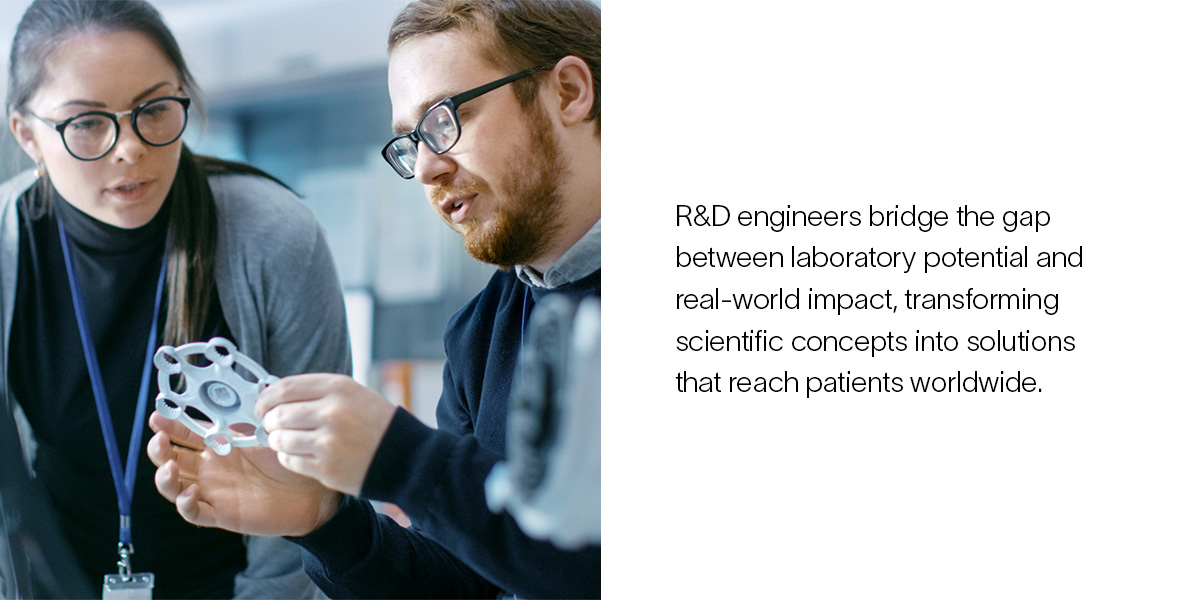
Key Differences Between Research Scientists and R&D Engineers
Understanding career paths in science and engineering
| Category | Research scientists | R&D engineers |
|---|---|---|
| Primary focus |
Discovering new insights through hypothesis-driven research
|
Applying knowledge to create scalable, manufacturable products
|
| Typical education |
A PhD in biology, chemistry, biochemistry or related life science
|
Bachelor’s or master’s in biomedical, mechanical or chemical engineering
|
| Core skills |
Experimental design, data analysis, statistical methods, scientific writing and grant writing
|
CAD/prototyping, product testing, manufacturing processes and regulatory compliance
|
| Work output |
Publications, patents, research findings and grant proposals
|
Product designs, prototypes, technical specifications and manufacturing documentation
|
| Project approach |
Long-term exploration spanning months to years, requiring comfort with uncertainty
|
Defined milestones and deliverables with measurable success criteria
|
| Driving question |
“Why does this happen?”
|
“How can we make this work?”
|
Research scientists push the boundaries of knowledge.
R&D engineers bring practical expertise.
Educational pathways
Research scientists in life sciences typically require a PhD in fields like biology, chemistry, biochemistry or molecular biology. Doctoral training prepares scientists for independent research, experimental design and scientific communication. Completing a PhD typically takes four to seven years beyond bachelor’s studies.
R&D engineers follow a more direct path focused on applied problem-solving. Life sciences engineers in fields like biology and biomedical engineering typically need a bachelor’s degree for entry-level work. Many mid-career engineers pursue master’s degrees for specialization in areas like tissue engineering or medical device design. The typical timeline is four years for a bachelor’s, plus an optional two years for a master’s.
At Danaher, we value the deep domain expertise that PhD-trained research scientists bring. We also appreciate the practical problem-solving capabilities that trained R&D engineers offer. Associates can move between Danaher operating companies, exploring engineering or research science opportunities to find roles that match their evolving expertise.
Core skills
The skill requirements for each role reflect different problem-solving approaches. Research scientists develop expertise in designing experiments with rigorous controls, conducting statistical analysis and bioinformatics, writing for scientific publications and research grants, and mastering laboratory techniques like cell culture, genomics or proteomics. In-demand skills for scientific researchers include programming, data analysis, bioinformatics, statistical modeling and machine learning, depending on the application. These capabilities support hypothesis-driven research for scientific discovery.
R&D engineers develop expertise in computer-aided design (CAD) and technical drawing, prototyping and iterative testing, understanding manufacturing processes and constraints, managing cross-functional projects, and navigating regulatory compliance frameworks. In-demand skills for R&D engineers include CAD tools, prototyping and testing systems. Both roles increasingly require analytical thinking, comfort with learning advanced technologies, and strong communication skills.
These technical proficiencies are crucial for transforming scientific breakthroughs into market-ready solutions across Danaher’s diverse product portfolio. Both roles increasingly require analytical thinking, comfort with learning advanced technologies and strong communication skills, all of which are highly valued at Danaher.
Personality and work style
R&D engineers and research scientists tend to experience fulfillment from different sources.
Research scientists typically enjoy open-ended problems without predetermined solutions, feel comfortable when experiments yield unexpected data that prompts new questions, prefer diving deep into single questions over extended periods, and find satisfaction in publishing findings that advance the field. This curiosity-driven approach values advancing knowledge over immediate practical applications.
R&D engineers tend to prefer clearly defined problems with measurable success criteria, feel energized seeing designs become functional products, enjoy iterative improvement cycles that produce visible performance gains, and find satisfaction in products reaching patients. This solution-oriented mindset values practical impact over theoretical explanations.
At Danaher, both personality types find a fulfilling environment where their unique contributions accelerate progress in life sciences.

Career progression and outlook
Both careers provide strong growth potential, job security and competitive compensation, though their advancement criteria differ.
The Research Scientist career path
Typically, junior research scientists enter post-PhD, assisting with experiments under supervision while building their publication record. Research scientists manage independent projects, lead experiments and publish research.
At companies like Danaher, senior research scientists lead research programs, mentor junior scientists and provide strategic direction. Principal research scientists function as field experts who define research strategy and guide scientific direction.
Advancement depends on publication record and research impact, grant acquisition success, leadership abilities and scientific innovation.
The R&D Engineer career path
The R&D engineer’s career path progresses through levels based on technical expertise and project leadership.
- Entry-level R&D engineers support senior engineers with testing and documentation.
- Mid-level R&D engineers manage projects independently and lead small teams.
- Senior R&D engineers lead large-scale projects and mentor junior engineers.
- Principal engineers set technical direction for product lines and may transition to management roles.
Advancement depends on successful product launches, technical expertise, cross-functional leadership and process improvements.
Salaries for Research Scientists and R&D Engineers
Research scientist and R&D engineer careers offer strong earning potential. For example, medical scientists earn a median annual salary of $100,590. Biomedical engineers and bioengineers earn a median annual salary of $106,950. The highest salaries R&D engineers and research scientists earn are well over $160,000.
These occupations are projected to grow faster than the average across the job market.
Can you transition between R&D Engineer and Research Scientist roles?
While careers in research science and R&D engineering have different demands, transitioning from one to the other is feasible with intentional skill development.
A research scientist with engineering coursework or a relevant master’s degree can make a strong applicant for R&D engineering roles. Research scientists can apply their experimental design skills to systematic troubleshooting, their data analysis expertise to product testing and optimization, and their extensive domain knowledge to product development decisions.
The transition typically requires:
- Learning CAD software and technical drawing conventions.
- Understanding manufacturing processes and constraints.
- Mastering regulatory frameworks like ISO and FDA requirements.
- Developing project management skills for cross-functional coordination.
Moving from R&D engineer to research scientist is more challenging without a PhD, but possible at the master’s level for applied research roles. Engineers can leverage their technical skills and product development experience, problem-solving abilities, and understanding of practical constraints to inform research directions.
The transition may require:
- Strengthening experimental design and hypothesis formulation skills.
- Developing statistical analysis and bioinformatics capabilities.
- Building scientific writing proficiency for publications.
- Pursuing a PhD for senior research science positions.
Danaher’s large portfolio of operating companies offers opportunities for research scientists and R&D engineers looking to explore the height and breadth of their career potential. Some Danaher companies offer hybrid research engineer positions that blend both skill sets for professionals who value discovery and practical application.
Find your path to life-changing innovation at Danaher
Whether you pursue experimental breakthroughs as a research scientist, design and test market-ready solutions as an R&D engineer, or combine elements of both as a research engineer, Danaher provides opportunities for you to shape the future of global human flourishing.
At Danaher, life sciences professionals find careers where scientific curiosity and engineering excellence solve health care’s biggest challenges. Our operating companies provide the resources, collaboration and culture of continuous improvement you need to realize your career potential.
Explore Life Sciences career opportunities at Danaher and discover how your talents can contribute to innovations that improve lives.