
The world’s most future-facing scientists, researchers and entrepreneurs can collaborate to make drug discovery faster, safer and more predictive for real human health. However, the traditional preclinical models aimed at achieving these goals, like animal studies and 2D cell cultures, still fall short and fail to capture the complexity of human biology. Over the last few decades, rapid advances in organoid technology have given us a compelling solution to drug safety challenges.
Organoid development revolutionizes how we model disease, test drugs and personalize medicine, and Danaher stands at the forefront of this revolution. Danaher’s end-to-end organoid development solutions set new standards for scalability and impact. Read on to discover the impact of Danaher’s organoid platforms, why this matters and how you can be part of this mission.
Table of Contents
- The Science Behind Organoids and Drug Safety
- Danaher’s Organoid Development Solutions
- Careers in Organoid Science
- Our Impact: Creating a Safer Future for People Around the World
- 4 High-Impact Applications of Organoids
- Our Mission at Danaher
- Build a Safer Future at Danaher
The Science Behind Organoids and Drug Safety
Organoids are miniature, three-dimensional models of human organs grown from stem cells, primary cells, cell lines or cancer cells. They are often more effective than 2D cell cultures or animal models because they replicate the complexity, cell diversity and function of real human tissues. This allows researchers to study drug responses, metabolism and toxicity in a system that reflects human biology.
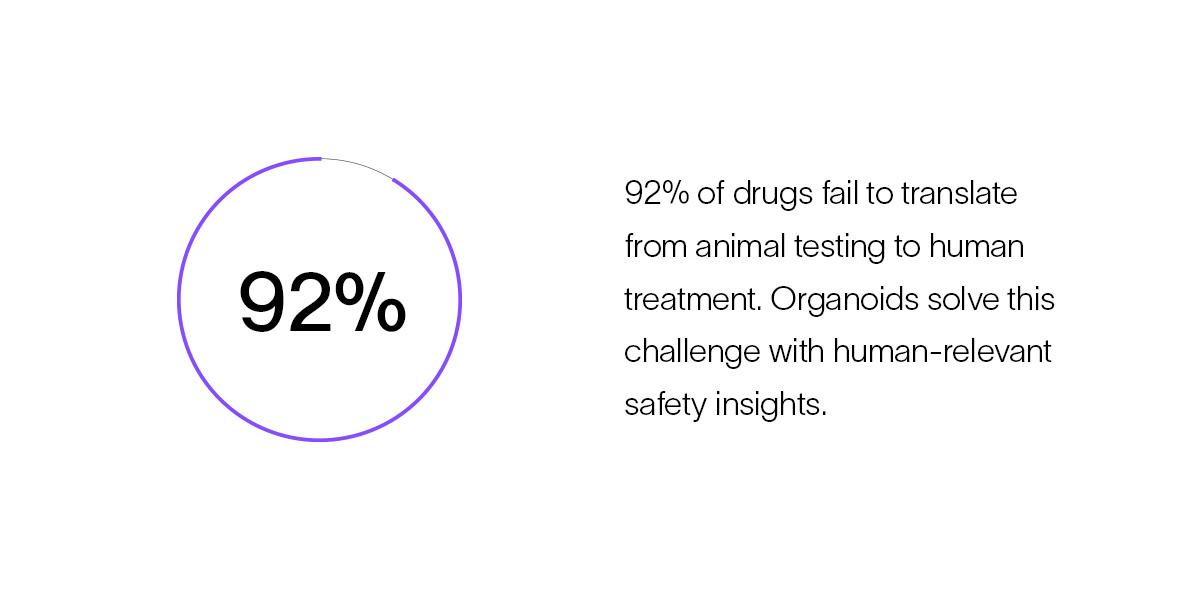
Reliable drug safety research protocols are crucial to preventing the massive loss of time, money and opportunities and delivering lifesaving care resulting from late-stage drug failures. Over 92% of drugs showing promise in animal models fail in human trials, often due to unforeseen toxicity or inefficacy.
In contrast, organoid-based models help reduce late-stage drug failure rates by providing more human-relevant data. Danaher’s organoid development solutions empower researchers to test drug candidates in systems that are far more predictive of human responses than traditional models. The benefits of our solutions include:
- Earlier detection of toxicity and off-target effects.
- More accurate prediction of efficacy.
- Reduced reliance on animal testing.
- Faster, more cost-effective drug development cycles.
Danaher’s Organoid Development Solutions
Danaher’s family of operating companies delivers a comprehensive suite of products and technologies that support every stage of organoid development, from sample preparation to advanced data analysis:
- Abcam is Danaher’s provider of high-quality antibodies, growth factors and animal-free matrices. These reagents help identify, isolate and culture cells to create robust organoid models.
- Beckman Coulter offers automated instruments for tissue dissociation, cell washing, centrifugation and cell counting. These devices ensure that researchers can prepare clean, viable cell populations for successful organoid formation.
- Molecular Devices supplies our high-content imaging systems, such as the ImageXpress platform. These technologies enable real-time monitoring, phenotypic screening and quantitative analysis of organoid growth and function.
- Leica Microsystems provides advanced microscopes and imaging solutions. These tools let scientists visualize organoid structures and cellular details with exceptional clarity throughout the development process.
- IDBS delivers workflow management and data tracking platforms. These software solutions help laboratories maintain sample traceability, ensure regulatory compliance and document the organoid workflow.
- Genedata offers data integration and analytics software. This platform enables high-throughput screening, hit selection and multiomics analysis, turning complex organoid assay data into actionable insights.
- Sciex manufactures mass spectrometry systems for in-depth metabolite and protein characterization of organoids, supporting comprehensive functional and safety assessments.
- Phenomenex produces chromatography columns and consumables for sample preparation and analytical separation, facilitating detailed biochemical analysis of organoid samples.
Together, these Danaher companies provide the integrated technologies and expertise researchers need to automate and improve organoid workflows. By leveraging this portfolio, scientists can accelerate discovery, enhance reproducibility and generate more predictive data for safer drug development.
Careers in Organoid Science
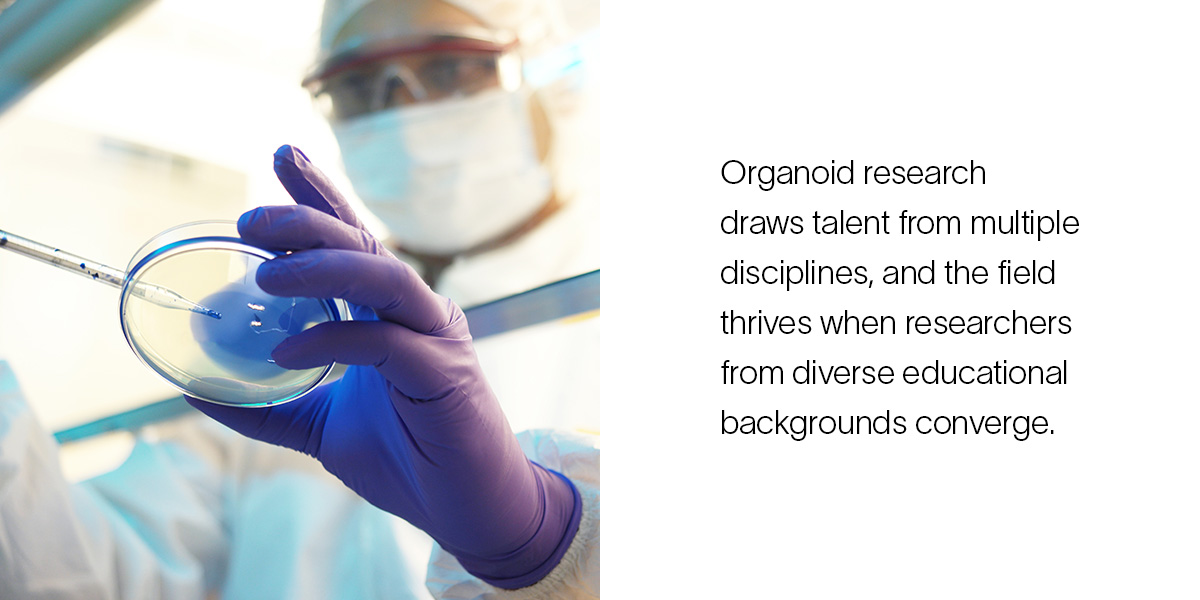
The organoid revolution opens doors to meaningful careers for scientists, technicians and specialists who want to accelerate drug discovery and improve human health. Whether one is fresh out of graduate school or pivoting from another field, organoid science welcomes curious minds ready to tackle complex challenges. The field combines cutting-edge biology, advanced technology and inspiring collaborations, creating an environment where daily contributions shape the future of medicine.
Organoid research draws talent from multiple disciplines, and the field thrives when researchers from diverse educational backgrounds converge. Professionals attracted to science, technology or problem-solving will find a role that matches their strengths and aspirations.
Common Positions in Organoid Science
While the horizons of possible contributions to organoid science are expanding, today’s popular organoid careers include:
- Research scientists: These professionals lead organoid development projects by designing experiments, analyzing data and publishing findings. They mentor junior team members, collaborate across departments and drive innovation. Most research scientists hold advanced degrees, while others transition from industry or technical roles.
- Laboratory technicians: Technicians support research scientists by preparing samples, maintaining organoid cell cultures, conducting assays and collecting data. They develop deep expertise in laboratory protocols, often becoming specialists in specific techniques. Many advance into senior technical roles or pursue graduate degrees to become research scientists. This role welcomes professionals with bachelor’s degrees in biology or related disciplines, but also those with strong technical backgrounds from other fields.
- Data scientists: These professionals transform raw organoid data into actionable insights. They build computational models, analyze high-throughput screening results and identify patterns that guide drug discovery decisions. Data scientists may have backgrounds in bioinformatics, computational biology, data science, computer science or even physics. Each background brings different perspectives to complex data challenges. The role rewards problem-solving abilities and curiosity about biological systems.
- Regulatory and quality specialists: These specialists ensure organoid workflows meet rigorous standards for reproducibility, safety and compliance. They document procedures, troubleshoot inconsistencies and help companies navigate regulations. This work demands systematic thinking and attention to detail. Many professionals entering these roles transition from quality management, regulatory affairs or life sciences backgrounds.
- Process engineers: Engineers scale organoid production from research labs to industrial settings. They design automated systems, optimize workflows and solve real-world challenges that arise during scale-up. These professionals apply engineering principles to biological systems, turning laboratory discoveries into life-changing treatments. Biomedical, chemical, process and other engineering backgrounds can lead to meaningful work in process engineering for organoid development.
Experience and Educational Pathways for Organoid Science Careers
There are many educational and professional paths into organoid science. A bachelor’s degree in biology, chemistry, biochemistry or a related life science provides a solid foundation. From there, professionals can launch into technician roles, where they gain hands-on experience while deciding whether to pursue advanced degrees.
Many professionals pursue master’s degrees in fields like cell and molecular biology, biomedical sciences or bioinformatics. PhD programs in biology, biochemistry or related disciplines prepare professionals for independent research leadership, but a PhD is not required for all organoid careers. Many technicians, engineers and specialists thrive with bachelor’s or master’s degrees.
Beyond formal education, continuous learning can contribute to a successful career in organoid science. Professionals who attend conferences, pursue certifications and stay curious about emerging techniques position themselves for ongoing career growth.
Getting Started in Organoid Science
The right path into organoid science depends on one’s interests. Someone passionate about hands-on laboratory work can explore technician positions or entry-level research roles. Those drawn to data and computational challenges can investigate data science opportunities, while professionals interested in scaling solutions and solving engineering problems can pursue process engineering roles.
At Danaher, professionals benefit from a unique advantage, which is the ability to grow careers across a network of specialized companies. Danaher’s portfolio of operating companies — including Abcam, Beckman Coulter, Molecular Devices, Leica Microsystems, IDBS, Genedata, Sciex and Phenomenex — offers exciting opportunities across all these career paths. Explore life sciences careers at Danaher to start your journey in organoid science.
Our Impact: Creating a Safer Future for People Around the World
At Danaher, we transform drug discovery through organoid models that reflect the complexity of human biology. Organoids can replicate the architecture, cell diversity and function of real human organs to an extent impossible for traditional 2D cell cultures or animal models. This lets researchers capture disease-specific mutations, account for patient heterogeneity and monitor microenvironmental cues.
Organoid fidelity improves drug discovery through:
- Disease modeling: Organoids can model diverse human diseases, including cancer, genetic disorders and infectious diseases.
- Drug metabolism and toxicity: Organoids express the same drug-metabolizing enzymes and transporters as their tissue of origin, allowing for more accurate prediction of drug clearance and side effects.
- Personalized medicine: Patient-derived organoids can be used to test individual responses to therapies, allowing for personalized treatment strategies.
Organoids vs. Animal Models
Traditional animal models often fail to predict human-specific responses because of interspecies differences in metabolism, immune function and genetic regulation. Less than 8% of drugs that succeed in animal models ultimately prove safe and effective in humans. Human-derived organoids retain the donor’s unique genetic and epigenetic landscape, enabling more accurate modeling of efficacy and toxicity. This is crucial for studying rare diseases, diverse patient populations and complex drug interactions.
Harnessing Organoid Variation
Danaher’s organoid platforms support a remarkable variety of tissue types, including:
- Liver organoids for modeling drug metabolism and hepatotoxicity.
- Cardiac organoids for assessing arrhythmogenic risk and cardiotoxicity.
- Intestinal and colorectal organoids for absorption, microbiome and cancer studies.
- Brain and neural organoids for neurotoxicity and neurodevelopmental disorder research.
This allows for multi-organ interaction studies, which are essential for understanding systemic drug effects and off-target toxicities.
Organoid-on-a-Chip and Microfluidic Innovations
Danaher’s platforms empower researchers to advance multi-organoid and organ-on-a-chip studies by providing the automation, imaging and analytical tools needed to support integration of multiple organoids within a single microfluidic system. These systems allow for:
- Vascularization and perfusion: These processes help to overcome the size and maturation limits of traditional organoids by providing a blood vessel-like network that delivers nutrients and oxygen.
- Multi-organ interactions: Connecting different organoids, like liver, heart and kidney models, on a single chip allows researchers to study systemic drug effects and toxicity.
- Real-time monitoring: Organoid-on-a-chip systems support continuous assessment of organoid health, function and drug response.
4 High-Impact Applications of Organoids
By supporting organoid research, development and testing, Danaher helps to drive advances in:
- High-throughput drug screening: Danaher’s platforms enable rapid, parallel testing of hundreds of compounds on organoids, accelerating discoveries. Automated liquid handling, imaging and data analysis allow for unbiased screening at a scale unattainable with traditional models.
- Personalized care: By creating organoids from patient biopsies, researchers can predict which drugs will work best for each individual, reducing trial-and-error and improving outcomes. This approach helps guide therapy selection and monitor resistance in colorectal cancer, cystic fibrosis and rare genetic diseases.
- Regenerative medicine: Researchers explore organoids as sources for tissue repair and transplantation, offering hope for conditions once thought untreatable. For example, liver organoids have been shown to engraft and restore function in animal models of liver failure, and intestinal organoids are being tested for the treatment of inflammatory bowel disease.
- Disease modeling and mechanistic studies: Organoids allow researchers to model disease progression, study host-pathogen interactions and dissect the molecular mechanisms underlying drug resistance. For example, organoids have been used to identify new therapeutic targets in colorectal cancer and to study the impact of the microbiome on drug metabolism.
Our Mission at Danaher
Danaher is a global science and technology leader acceleratingthe real-life impact of tomorrow’s science and technology. A focus of many of our businesses, including Beckman Coulter, Molecular Devices and Abcam, is to provide tools, automation and digital solutions that enable researchers to develop, culture and analyze organoids. By empowering scientists with integrated, scalable workflows for organoid research, Danaher accelerates safer drug discovery and helps create a healthier future for people everywhere.
Build a Safer Future at Danaher
The world needs safer, more effective drugs, and leaders in the industry need partners who can deliver. At Danaher, you’ll join the mission to improve the future of health through science, technology and collaboration. Join Danaher if you want to be part of a team renowned for its:
- End-to-end solutions: From tissue sourcing to data analytics, Danaher offers a complete, integrated platform for organoid development and drug discovery.
- Global reach: Work alongside cross-disciplinary teams in a company with a worldwide impact.
- Culture of innovation: Danaher fosters a culture where new ideas are welcomed, and every team member feels empowered to make a difference.
- Ethical and sustainable science: Our solutions support ethical sourcing, sustainability and improving lives.
Are you ready to shape the future of drug discovery and human health? Explore your opportunities at Danaher today.