

Table of Contents
- What Does a Manufacturing Engineer Do?
- What Qualifications Are Needed to Be a Manufacturing Engineer?
- The “Hidden” Curriculum: Certifications That Stand Out
- Manufacturing Engineer Salary and Job Outlook
- The Manufacturing Engineer Career Path: From Entry-Level to Leadership
- Finding a Job: Strategies for Applicants
- Why Build Your Career at Danaher?
- Browse Open Manufacturing Engineer Jobs at Danaher
Manufacturing engineering unites technical knowledge, process innovation and a drive for quality. As industries advance and technology evolves, those in manufacturing engineering help shape how products move from the drawing board to daily use.
This career path is designed for individuals who thrive in problem-solving environments and are eager to see ideas come to life. Whether working in traditional sectors or fields like life sciences, manufacturing engineers are responsible for combining ingenuity with precision, meeting the demands of production while advancing standards for safety, performance and efficiency.
At Danaher, manufacturing engineers are the driving force behind cutting-edge diagnostic technologies, lifesaving medical devices and advanced laboratory equipment. Working across our portfolio of companies, engineers combine process innovation with the Danaher Business System (DBS) to deliver products that improve lives worldwide.
What Does a Manufacturing Engineer Do?
At its core, manufacturing engineering is the bridge between design and production. These professionals take a blueprint and figure out how to mass-produce it efficiently and safely. The role often requires designing custom tools or fixtures, identifying automation opportunities, and fine-tuning processes to maximize throughput and minimize waste. An engineer’s success in this field is largely based on their adaptability and collaboration skills.
Life Sciences Context
Within the life sciences sector, the work of a manufacturing engineer gains even greater significance. Unlike general manufacturing, which might focus on consumer devices or industrial parts, producing diagnostics, medical instruments or pharmaceutical devices significantly raises the stakes. Precision manufacturing is essential for patient safety.
Day-in-the-Life Snapshot
The role of a manufacturing engineer unfolds in a dynamic, fast-paced setting. Each day brings new challenges and opportunities to solve complex problems, drive process improvements and contribute to the development of cutting-edge products. From tackling unexpected obstacles to optimizing workflows, manufacturing engineers combine analytical thinking with on-site action.
A typical day might include:
- On the shop floor (gemba): Manufacturing engineers spend a lot of time where products are made, directly observing processes. Being present on the shop floor allows engineers to identify inefficiencies, address issues as they arise and validate improvements in real-world conditions.
- Clean room work: In medical device and life sciences settings, there’s a higher emphasis on contamination control. Working in a clean room requires adherence to gowning protocols and contamination prevention measures to ensure every product meets stringent safety standards.
- Collaboration: This role demands constant coordination with research and development, quality assurance and regulatory affairs. An engineer must balance technical requirements with compliance, commercial goals and novel innovation.
Manufacturing Engineers at Danaher
At Danaher, manufacturing engineers are known for their hands-on experience on the manufacturing floor, solving real-time challenges in highly regulated environments. Whether it’s implementing lean process improvements at Beckman Coulter or finding real-time solutions for Mammotome, Danaher engineers ensure medical products meet stringent quality and safety standards for global healthcare markets.
Take a look at some positions you might find at Danaher:
- Manufacturing Engineering, Mechanical: This team member is responsible for improving and sustaining complex manufacturing systems. The candidate performs validation activities, executes failure analysis and leads cost-reduction initiatives.
- Manufacturing Engineering, Electrical: An Electrical Manufacturing Engineer aids in improving healthcare through molecular diagnostic systems and tests. This team member implements design changes to ensure supply chain continuity, oversees contract manufacturers and suppliers, modifies PCB layouts, and supervises component testing.
- Senior Manager, Manufacturing Engineering: The Senior Manager helps optimize production processes. This role includes overseeing new product introduction, implementing advanced technologies and managing collaboration and projects.
What Qualifications Are Needed to Be a Manufacturing Engineer?
Manufacturing engineering welcomes individuals from a variety of educational and professional backgrounds, though certain qualifications can help with job placement and career advancement.
Manufacturing Engineer Education Requirements
Many positions require a bachelor’s degree, often in mechanical, industrial, biomedical or chemical engineering. These areas of study offer a foundational knowledge of materials science, production methods, quality control and process optimization necessary for manufacturing roles.
Although a bachelor’s degree remains the industry standard, there are additional avenues into the field. Specialized certifications in areas like plastics, welding or automation can supplement a candidate’s credentials, especially if the candidate also has extensive experience as a technician. In some cases, demonstrated hands-on expertise can bridge education gaps.
While most Danaher engineers start with a bachelor’s degree in engineering or a related field, many also join through our early career development programs or after gaining hands-on experience in highly regulated industries. Continuous learning is a core value at Danaher. Our associates have ongoing access to specialized Danaher training in lean manufacturing, Six Sigma and advanced data analytics.
Essential Skills for a Manufacturing Engineer
Beyond education, manufacturing engineers must possess a range of technical and interpersonal skills. Some manufacturing engineer requirements include:
- Mastery of CAD software: Understanding tools for designing components, tooling and modifications is essential for manufacturing engineers. Proficiency in computer-aided design supports rapid iteration and precise documentation.
- Data analysis: Manufacturing environments generate large volumes of information. Candidates must have familiarity with statistics, often through experience with tools like Excel or Python. This familiarity enables an engineer to analyze yield trends, initiate root cause investigations and evaluate process capability studies.
- Regulatory knowledge: Regulatory knowledge is crucial for ensuring product quality, particularly in life sciences.
Manufacturing engineers must also possess several soft skills to succeed in the industry. These skills can set candidates apart and highlight their compatibility with the field.
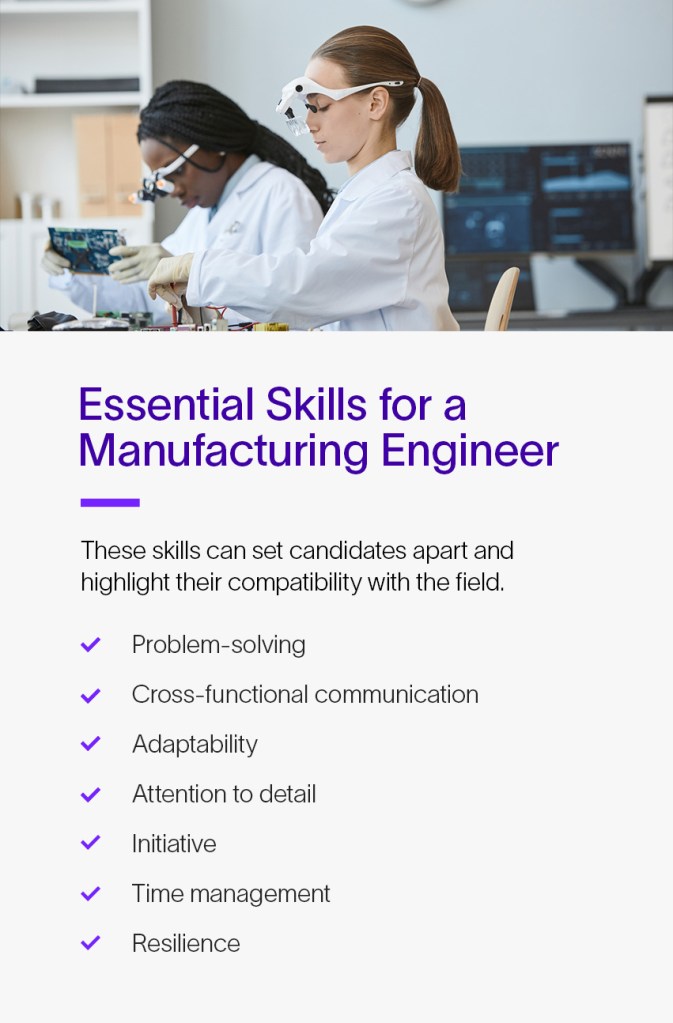
- Problem-solving: Manufacturing engineers must have the capacity to address unexpected issues and move toward solutions, often under tight deadlines.
- Cross-functional communication: Effective manufacturing engineers translate complex technical concepts for peers in production, quality and supply chain.
- Adaptability: Manufacturing technology and processes change rapidly. A willingness to learn and embrace new methods is important.
- Attention to detail: Carefully monitoring processes and documentation helps prevent costly errors and ensures compliance with quality standards.
- Initiative: Proactively identifying areas for improvement and sharing new ideas can drive innovation and efficiency.
- Time management: Prioritizing tasks allows engineers to meet project deadlines and respond swiftly to production challenges.
- Resilience: A positive, persistent attitude, especially during setbacks or unexpected difficulties, helps engineers maintain productivity and morale in dynamic environments.
The “Hidden” Curriculum: Certifications That Stand Out
While a formal engineering education lays the groundwork, an increasingly competitive manufacturing sector places a premium on continuous professional development. Earning manufacturing certifications can help engineers expand their professional expertise.
- Lean Manufacturing: Lean manufacturing methodologies equip manufacturing engineers to identify waste, streamline processes and minimize defects. Mastering these continuous improvement tools underpins many improvement initiatives across the country.
- Six Sigma: Six Sigma enables professionals to manage and lead improvement projects. Curriculum typically involves statistics, process control techniques and process definition.
- Certified Manufacturing Engineer (CMfgE): This certification from the Society of Manufacturing Engineers demonstrates deep technical knowledge of manufacturing processes. CMFgE certification is ideal for engineers who have supported manufacturing processes within their organization and for those in leadership roles.
- Certified Production Technician (CPT): Completing the CPT program highlights an engineer’s experience with production processes. This certification can help professionals advance their careers as manufacturing team leads, production supervisors and production technicians.
- Certified quality engineer: Becoming a certified quality engineer allows professionals to understand more about evaluation processes. Applicants commonly examine topics like quality standards, documentation procedures, quality audits and quality management systems.
- Certified Manufacturing Technologist (CMfgT): CMfgT programs expand knowledge regarding quality control procedures and safe manufacturing. These certifications can help professionals become quality control manufacturing technologists.
- Project Management Professional (PMP): PMP certification isn’t exclusive to engineering, but can become particularly useful at the senior and managerial level, especially when the focus shifts toward leading cross-functional teams and major initiatives.
Manufacturing Engineer Salary and Job Outlook
Compensation for manufacturing engineers varies based on factors such as industry focus, experience and geography. According to the U.S. Bureau of Labor Statistics, the median annual wage for an industrial engineer is $101,140.
- Entry level: Engineers starting out typically see salaries reflecting their technical education, with additional compensation for relevant internships or specialized skills.
- Mid-level: With experience, salary potential increases significantly, especially for those who demonstrate leadership in key operational improvement or innovative process designs.
- Leadership roles: Those advancing to management or principal engineer roles often see further increases, consistent with broader responsibility for people, budget and strategy.
Industry data regularly shows that the medical equipment and supplies manufacturing sector rewards manufacturing engineers with notably higher median salaries compared to other manufacturing branches. This compensation reflects both the stricter regulatory burden and the importance of precision and quality control.
In terms of career outlook, biopharma and medtech manufacturing continue to experience growth, fueled by demographic trends, regulatory innovation and a focus on public health. The demand for engineers skilled in automation and data analytics is expected to remain strong for years to come.
At Danaher, we complement competitive compensation with a strong culture of recognition and frequent opportunities for career mobility. Team members can move from process engineering into leadership, quality, supply chain, and research and development roles within our global organization.

The Manufacturing Engineer Career Path: From Entry-Level to Leadership
A typical career progression for a manufacturing engineer often follows these stages:
- Engineer l: Individuals in their first role take on supporting tasks, like solving small production issues, learning plant operations and shadowing senior engineers. The focus is on foundational skills and exposure to standard processes.
- Senior manufacturing engineer: Increased responsibility includes leading improvement projects, mentoring less-experienced team members and taking ownership for specific production lines or product families.
- Principal engineer: Recognized as technical experts, principal engineers solve the most complex systemic problems and often guide company-wide initiatives, standards or large-scale technology transitions.
- Engineering manager: As leaders, engineering managers shift from direct technical work to managing teams, developing strategy, overseeing hiring and aligning engineering with business objectives.
A defining feature of large manufacturing organizations, especially in systems-driven companies, is the “jungle gym” approach to career development. Career moves often include transitions into related domains, such as quality assurance, supply chain or research and development. Engineers can broaden their experience and build versatility without leaving the organization.
Danaher’s engineering career path is especially dynamic. Through the Danaher Leadership Development Program, promising engineers rotate across disciplines, mentor with senior leaders and gain direct experience at the forefront of healthcare manufacturing. Read our associate stories to see how engineers have used internal mobility to grow and lead new teams.
Finding a Job: Strategies for Applicants
With a solid resume detailing their experience, skills and education, individuals can start applying to engineering roles. These tips can help professionals find and secure their first job:

- Build an optimized resume: An engineering resume should be clear and actionable and use industry-recognized keywords to get past hiring software. For example, terms like “root cause analysis” or “process validation” can catch the attention of recruiters and automated filters.
- Try specific search terms: Customize online job searches with the right terms. Those wanting to apply for a specific role or a job with a certain skill can use detailed search queries to find the perfect job openings for their experience. Experiment with different job titles to find the best matches.
- Use internships and co-ops: Relevant work experience remains the single most effective way to prove capability. Both internships and co-op placements in regulated industries can expose applicants to helpful skills and experience. Use industry connections from these opportunities to find open roles.
- Prepare for interviews: Successful candidates should be prepared to talk about their experience, skills and interest in the company and role. It can help to discuss real-world examples and stories about navigating problems and working well with teams.
Applying for a Position at Danaher
We make it easier to prepare for interviewing at Danaher by setting expectations up front. We encourage candidates to become familiar with our businesses, values and culture. Candidates should be able to effectively explain how their skills and backgrounds align with our job descriptions. We also love to see candidates go the extra mile, bringing thoughtful questions about our company and individual roles.
When applying for manufacturing engineering roles at Danaher, emphasize lean process experience, compliance with regulated manufacturing and a track record of improvement projects. Our recruiters value candidates who can share real-world examples, especially those from internships or co-op roles at Danaher companies, where many associates have launched thriving careers.
For more insight into Danaher recruitment, take a look at our five-step process:
- Submitting an application: Candidates begin their journey by submitting their resume. Danaher also prompts candidates to create a homepage, where they can monitor candidacy status and apply to other interesting roles.
- Completing an introductory call: A Danaher hiring team member will reach out to selected candidates and schedule a call. During this 30- to 45-minute call, candidates will share more about their experience and be able to ask clarifying questions about the company and role.
- Conducting interviews: Within two weeks of completing the phone screening, candidates moving forward will go through an interview process and meet stakeholders or team members.
- Receiving an offer: Selected candidates will receive a written and verbal offer within 5 to 10 days after their final interview.
- Accepting an offer: Candidates who accept our offer will receive new-hire paperwork and complete any essential pre-employment screening if applicable. Team members can expect to start their new position within three to four weeks after accepting our offer.
Why Build Your Career at Danaher?
For those wanting to make a lasting impact each day, few places rival the sense of purpose found at Danaher. Here, manufacturing engineering is more than a technical function. When a new diagnostic device reaches a hospital faster, or a medical test becomes more reliable, success can often be traced back to a team of Danaher engineers dedicated to turning big ideas into real-world breakthroughs.
What truly sets Danaher apart is our culture of relentless improvement. Powered by the Danaher Business System, we make continuous improvement a daily pursuit. Employees at every level are empowered to challenge the status quo, experiment with novel solutions and see their ideas realized on a global stage.
For manufacturing engineers, that means never being stuck in neutral. Fresh challenges appear with each product launch and process upgrade, and teams collaborate dynamically, sparking growth for both individuals and ideas. Access to leading-edge tools, training and analytics provides not just a job, but a true launchpad for innovation.
Danaher’s internal mobility is another major advantage. Initiatives like the Leadership Development Program make it possible to explore different roles and specialties in manufacturing, quality, research and development, and supply chain without ever having to change companies. This environment rewards curiosity and ambition. Career paths evolve as skills and interests grow, and leadership development is built into the culture from day one.
Perhaps most exciting of all is the connection to something bigger. At Danaher, everything connects directly to global health outcomes. Manufacturing engineering at Danaher means the satisfaction of knowing that everyday efforts in the plant or at the whiteboard translate into healthier, safer communities worldwide.
Browse Open Manufacturing Engineer Jobs at Danaher

Manufacturing engineering is a field defined by innovation, responsibility and continual growth. As manufacturing challenges evolve, those who pursue this path have a chance to shape industries and improve lives. The future promises new opportunities for engineers ready to embrace complexity and create meaningful change.
At Danaher, you can be a part of world-changing work. Ready to make a tangible impact? Explore our open manufacturing engineering roles today.