At Danaher, our people drive life-transforming innovations, working across a network of companies united by a common goal — improving lives by advancing science and technology. Our companies provide the tools and systems that turn research into real-world health solutions. Here you can explore the essential role Danaher and our businesses play in accelerating drug discovery and development while delivering safer, more effective therapies – and how you can become part of this innovative work.
Table of Contents
- How Danaher’s Innovations Drive Better Health
- 1. Harnessing AI in Drug Discovery
- 2. Integrated Data Management and Workflow Automation
- 3. High-Throughput Screening and Organoid Technology
- 4. Advanced Bioanalytical Measurement
- 5. End-to-End Solutions
- 6. Cross-Company Collaboration for Holistic Innovation
- 7. Precision Medicine
- 8. Supporting Regulatory Compliance
- 9. Expanding Global Access
- About Danaher
- Join the Future of Drug Discovery and Development at Danaher
How Danaher’s Innovations Drive Better Health
Here are nine of the many ways Danaher is shaping the future of health innovations.
1. Harnessing AI in Drug Discovery
Across Danaher, we use AI to accelerate every stage of drug discovery. For example, Genedata’s platforms apply predictive analytics based on machine learning to sift through screening and omics datasets, identifying promising candidate drugs for validation. Meanwhile, Integrated DNA Technologies (IDT) AI models optimize the guide RNA sequences for clustered regularly interspaced short palindromic repeats (CRISPR) experiments, minimizing off-target effects and improving editing efficiency.
These tools also predict absorption, distribution, metabolism and excretion (ADME) properties and toxicity profiles early, letting our teams prioritize safer and more effective compounds before synthesis. Our state-of-the-art AI applications reduce the time and cost of early-stage drug development while increasing the probability of success. Scientists and researchers who want to drive the next AI-powered wave of drug innovation will leverage skills like:
- Machine learning (ML) and deep learning: Building and applying models like transformers, generative AI and reinforcement learning for drug discovery.
- Bioinformatics and computational biology: Analyzing genomic, proteomic and molecular data to uncover therapeutic insights.
- Chemoinformatics and structural modeling: Using tools like RDKit, docking and SAR modeling to design and evaluate drug candidates.
- Data handling and integration: Managing large, complex biomedical datasets and combining clinical, molecular and real-world evidence.
- Drug discovery and development: Understanding the pharmaceutical pipeline, from target identification through clinical trials, to apply AI meaningfully.
By developing these skills, professionals can unlock career opportunities working with AI in science, including:
- AI/ML research scientist: These scientists design and experiment with novel AI/ML methods for drug discovery, target identification or molecular design.
- Bioinformatician: This role focuses on omics data, biological sequence and structure modeling and integrating molecular and clinical datasets for therapeutic insights.
- Drug discovery data scientist: These data scientists work in cross-functional teams to apply AI across the drug discovery pipeline steps.
- Automation research scientist: These scientists develop automated protocols for laboratory workflows, validate instrumentation performance and bridge computational design with experimental testing to optimize drug discovery processes.
- Field applications scientist: These scientists validate computational tools with customers, troubleshooting challenges and gathering real-world feedback to inform product development and AI model improvements.
2. Integrated Data Management and Workflow Automation
Danaher operating companies, like IDBS and Genedata, provide data management and workflow automation solutions that streamline drug development processes. These platforms centralize experimental data from multiple devices and formats, automate repetitive tasks and ensure data integrity. As a result, researchers gain immediate access to accurate data to accelerate drug development, while maintaining records with built-in audit trails to comply with FDA and EMA requirements.
Data management and workflow automation careers include:
- Data scientists and analysts: Design and implement robust data architectures, ensuring data integrity and accessibility across complex research and development workflows.
- Scientific software engineers: Develop cutting-edge software solutions to automate laboratory processes and streamline the management and analysis of vast scientific datasets.
- Workflow automation specialists: Optimize experimental design and data flow, translating complex scientific processes into efficient, automated pipelines.
3. High-Throughput Screening and Organoid Technology
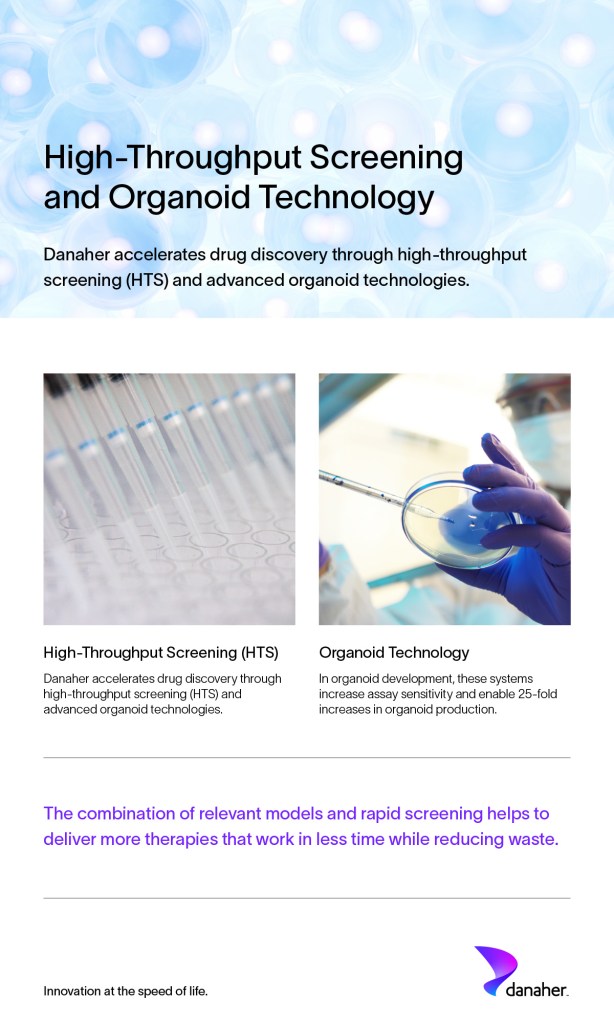
Danaher accelerates drug discovery through high-throughput screening (HTS) and advanced organoid technologies. Molecular Devices and Beckman Coulter Life Sciences offer automated platforms that can screen thousands of compounds against complex 3D cell models, like organoids, in a fraction of the time required by manual methods.
In organoid development, these systems increase assay sensitivity and enable 25-fold increases in organoid production. The combination of relevant models and rapid screening helps to deliver more therapies that work in less time while reducing waste.
Professionals interested in high-throughput screening and organoid technology can thrive as:
- Automation engineers: Design, develop and support automated platforms for high-throughput screening and complex cell culture workflows, including organoid development.
- Cell biologists: Apply deep knowledge of cell biology and 3D culture models to design and validate organoid-based assays and interpret biological responses to drug candidates.
- Image analysis specialists: Process, interpret and manage the vast amounts of imaging and screening data generated from high-content platforms, often leveraging AI and machine learning.
4. Advanced Bioanalytical Measurement
Through SCIEX and Leica Microsystems, Danaher delivers bioanalytical and imaging technologies for precise, high-resolution data on drug candidates and biological systems. For example:
- SCIEX’s mass spectrometry and capillary electrophoresis platforms empower detailed molecule characterization, supporting quality control and regulatory submissions.
- Leica Microsystems’ advanced microscopes facilitate spatial biology and real-time cellular imaging, critical for understanding drug mechanisms and effects.
These tools empower researchers to detect subtle changes, validate targets and monitor therapeutic responses, ensuring that only the most promising candidates advance through development.
Advanced bioanalytical measurement careers include:
- Mass spectrometry scientists: Operate, maintain and develop advanced mass spectrometry and capillary electrophoresis methods for precise molecule characterization and quantitation.
- Imaging scientists: Use cutting-edge microscopy and digital imaging techniques to visualize biological systems and analyze spatial biology data in real-time.
- Bioanalytical instrument engineers: Design, build and optimize high-performance bioanalytical instruments, ensuring their accuracy, reliability and seamless integration into complex research workflows.
5. End-to-End Solutions

Danaher’s integrated network of companies spans the drug development life cycle, from discovery to clinical manufacturing. For example:
- IDT supplies custom oligonucleotides for assay development.
- Molecular Devices supports high-throughput screening with automated imaging and analytics platforms.
- Pall provides bioprocessing solutions for purification and manufacturing.
- SCIEX delivers analytical platforms for quality control and regulatory compliance.
This broad perspective lets us eliminate silos and bottlenecks, minimize handoff errors and accelerate time-to-market.
End-to-end solutions offer career opportunities in roles like:
- Solutions architects: Design and implement integrated workflows and technological solutions, connecting various platforms and instruments across the drug development pipeline.
- Drug development project managers: Lead complex projects spanning the entire drug development lifecycle, coordinating efforts across different teams and technologies to ensure seamless progress from discovery to clinical manufacturing.
- Technical consultants: Partner with customers to understand their unique needs and configure tools and services into tailored, end-to-end solutions that optimize their research and development processes.
6. Cross-Company Collaboration for Holistic Innovation
Danaher’s operating companies share expertise, technologies and data to solve complex drug development challenges. We also collaborate with leaders — trailblazers in science, technology, research and business — to drive breakthroughs in areas like CRISPR gene editing, spatial biology and cancer drug screening. With capabilities spanning genomics, proteomics, bioinformatics and manufacturing, Danaher accelerates drug development innovations that improve safety, efficacy and accessibility of crucial therapies.
Careers in cross-company collaboration for holistic innovation include:
- Strategic alliance managers: Identifying, building and nurturing collaborations with academic institutions, industry partners and other organizations to drive joint research and development initiatives.
- Interdisciplinary R&D scientists: Scientists with expertise across multiple fields like genomics, proteomics and bioinformatics, capable of integrating diverse scientific approaches to solve complex challenges.
- Innovation program leaders: Leading and managing cross-company innovation programs, ensuring the effective sharing of expertise, technologies and data to accelerate breakthroughs in key areas like CRISPR gene editing and spatial biology.
7. Precision Medicine
Danaher supports the shift toward precision medicine through tools that enable the development of targeted therapies. For example, Abcam supplies validated antibodies and assays for biomarker discovery. IDT offers custom oligonucleotides for patient-specific diagnostics and therapeutics. These technologies help researchers identify and validate molecular targets, design personalized treatment regimens and monitor therapeutic responses with precision. This approach builds a future of safer, more inclusive therapies.
Precision medicine careers include:
- Genomic scientists: Develop and apply advanced gene-editing technologies, including CRISPR-based therapies, to create highly targeted and personalized treatments.
- Biomarker discovery scientists: Identify, validate and develop molecular indicators to guide personalized treatment regimens, monitor therapeutic responses and enhance diagnostic accuracy.
- Computational biologists: Integrate and analyze complex genomic, proteomic and clinical data to uncover patient-specific insights, design personalized therapies and optimize treatment strategies.
8. Supporting Regulatory Compliance
Navigating complex regulations is an obstacle to innovation that Danaher is helping biotechnology, life sciences and diagnostics companies overcome. Solutions like SCIEX’s validated analytical platforms, IDBS’ electronic lab notebooks and Pall’s GMP-compliant manufacturing systems support compliance through data traceability, electronic lab notebooks and validated analytical methods to meet quality and documentation requirements. Our expertise in Good Manufacturing Practice (GMP) and Good Laboratory Practice (GLP) environments helps our clients avoid costly delays, pass audits and bring products to market faster.
The regulatory compliance field includes career paths like:
- Regulatory affairs specialists: Interpret and apply complex global regulations to ensure all products and processes meet necessary compliance standards.
- Quality assurance engineers: Develop, implement and audit quality management systems, and ensure instrument and software validation for data integrity and product reliability.
- Compliance program managers: Oversee and coordinate compliance strategies across product development, manufacturing and data management to help innovative solutions reach the market.
9. Expanding Global Access
Danaher expands access to precision therapies and promotes equity in clinical research. Danaher’s data management and bioinformatics platforms, like those from Genedata and IDBS, help researchers track and analyze demographic and genetic data to ensure clinical trial participation. Tools from IDT and Abcam enable rapid screening for specific genetic markers, making it easier to enroll underrepresented populations and validate therapies across broader patient groups. The results include greater global health equity and better health outcomes across communities.
Professionals inspired to expand global health care access can pursue roles like:
- Global health program managers: Lead initiatives to broaden the reach of lifesaving therapies and diagnostic tools, focusing on addressing health care disparities and ensuring equitable access worldwide.
- Market access specialists: Develop strategies to introduce advanced scientific products and solutions into global markets, overcoming logistical and regulatory challenges.
- Clinical research coordinators: Manage clinical trials with an emphasis on recruiting diverse patient populations across different geographies, ensuring therapies are validated for broad applicability and promoting global health equity.
About Danaher
As a global science and technology innovator, Danaher brings together more than 20 businesses across life sciences, diagnostics and biotechnology. Our network includes industry leaders like:
- Abcam
- Beckman Coulter
- SCIEX
- Integrated DNA Technologies
- Molecular Devices
- Genedata
- Leica Microsystems
- IDBS
- Pall
By connecting expertise in genomics, bioinformatics, advanced instrumentation and manufacturing, Danaher delivers end-to-end solutions that accelerate the entire drug development process. This integrated approach means our teams can solve complex challenges faster and more effectively than companies working in isolation. Each company contributes specialized knowledge, but together, we create a collaborative ecosystem that drives measurable impact for researchers, clinicians and patients worldwide.
Join the Future of Drug Discovery and Development at Danaher
The future of drug discovery and development relies on people ready to innovate, collaborate and make a difference. At Danaher, you’ll find a culture that encourages learning, cutting-edge technology serving collaboration and a mission that prioritizes progress in solving the world’s most pressing health challenges. Whether you’re an experienced professional or just starting your career, Danaher offers you opportunities to grow and contribute to breakthroughs that improve lives.
Ready to accelerate your impact? Explore open positions and apply today.